


I’ve been thinking about prophets and holy fools. As the lectionary has danced through the book of Ezekiel, I am reminded of the similarities between the strange actions of the prophet and the actions of artists. This writing is a meditation on why I like thinking about art and why I continue.
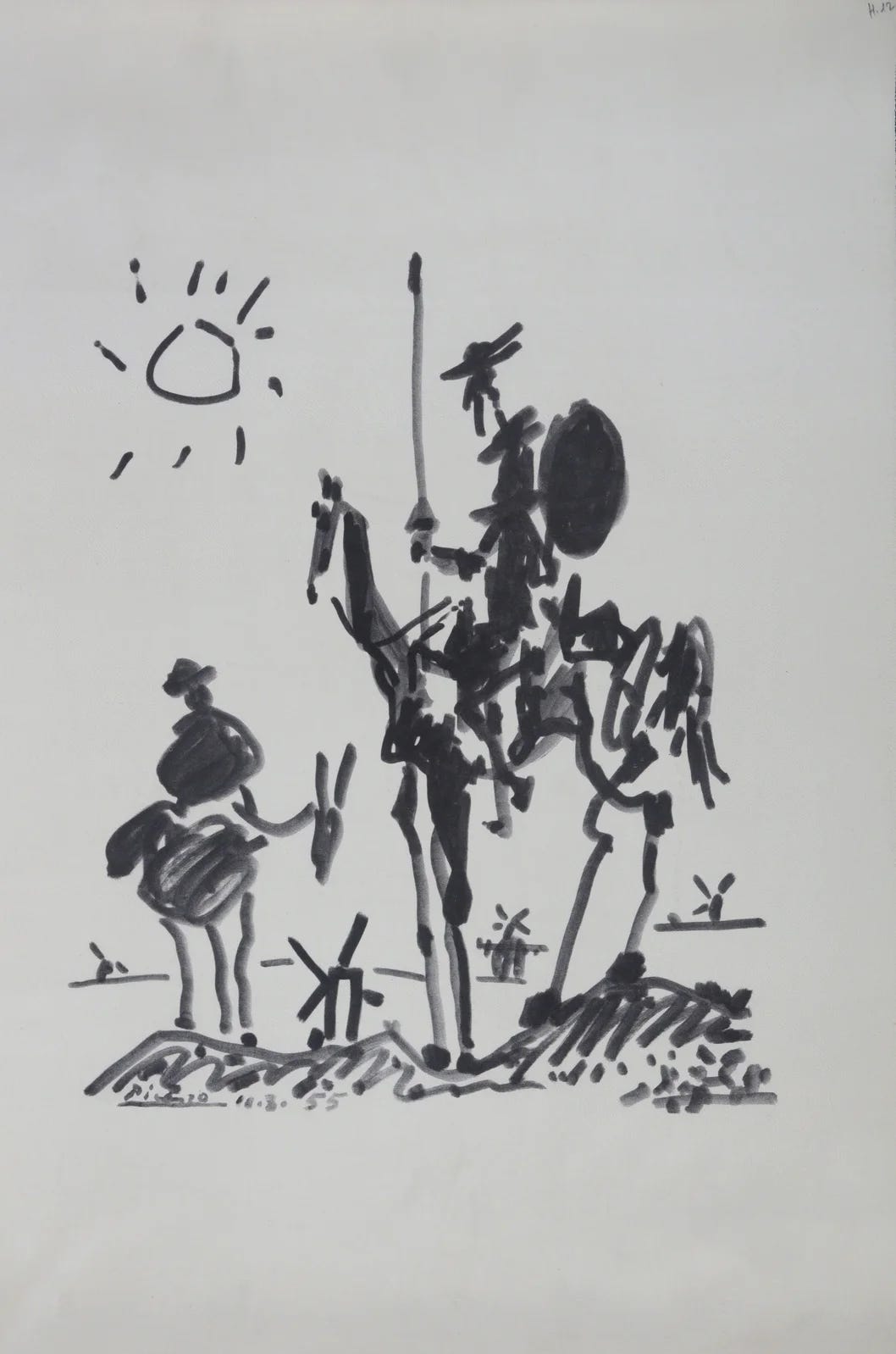
Don Quixote, 1955
By Pablo Picasso
In the book of Ezekiel, chapter 37, the prophet ties two sticks together with cord after having written the names ‘Judah’ and ‘Joseph’ on the separate pieces. It’s a prophetic metaphor which elicits a question from the people of Israel, who are in exile: “Will you not tell us what you mean by these?”
Though the action may seem strange, the meaning is straightforward. God will unite the disparate peoples associated with Judah and Joseph again. It’s a metaphoric symbol of hope.1
This is what art does. Art elicits the question “what does this mean?” from the viewer. Think about how many things and events you pass by in your day-to-day which you ignore. The sewage drains on the roadside, the leaves and birds overhead at all times, the shadows which march past you each day, the pan-handlers, the advertisements, the car horns, the lawn mower rumbles, the feel of your shirt on your back, the expansion of your chest every time you breathe, the bit of nose that is always in the middle of your view. All of these things are overlooked and ignored, until someone points them out.
Artistry is when an artist points to something.2 The artist frames some aspect of reality in a manner which seduces you into noticing it — or demands your attention.
Yet, mere noticing is not the end. The question must come to your mind. Things might happen throughout the day-to-day which force you into noticing one of the previously mentioned background aspects of your day. The beggar might vomit in front of you, the warmth of the sun on your skin might make you notice the shadow, the advertisement might use a particularly sexy model, the bird might wing your up-do, the lawn mower might gargle on a bit of gravel.
Beggar with a Wooden Leg, ca. 1630
By Rembrandt
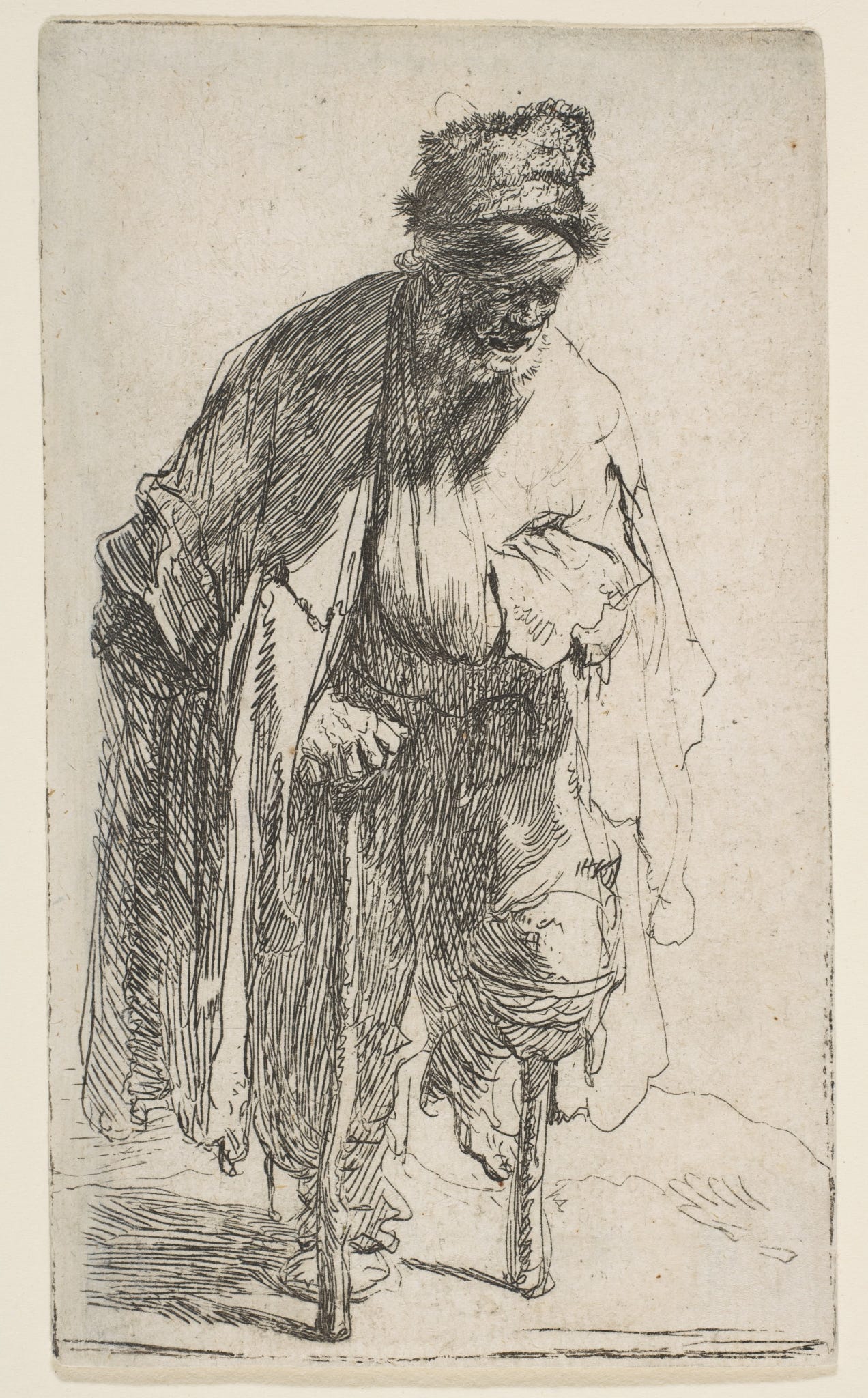
The meaning of these things is so apparent you do not need to ask the question — the beggar is a drunk or may be sick. The sun is hot and your skin can feel it. The larger than life image of a model has been airbrushed into the visual equivalent of sexual high-fructose corn syrup. The lawn mower, the man operating the machine, got too close to the flower bed. Before we even need to ask the question the answer is apparent. We do not need to search these situations for meaning.
When you look at the work of a human’s hands and its meaning or purpose is not apparent, you begin the process of either ignoring or investigating the mystery. You make the object meaningful by investigating it. You fill the object with meaning by asking the question. You are the meaning-perceiving part of the equation. The artwork is the thing which catalyzed the question in your mind.
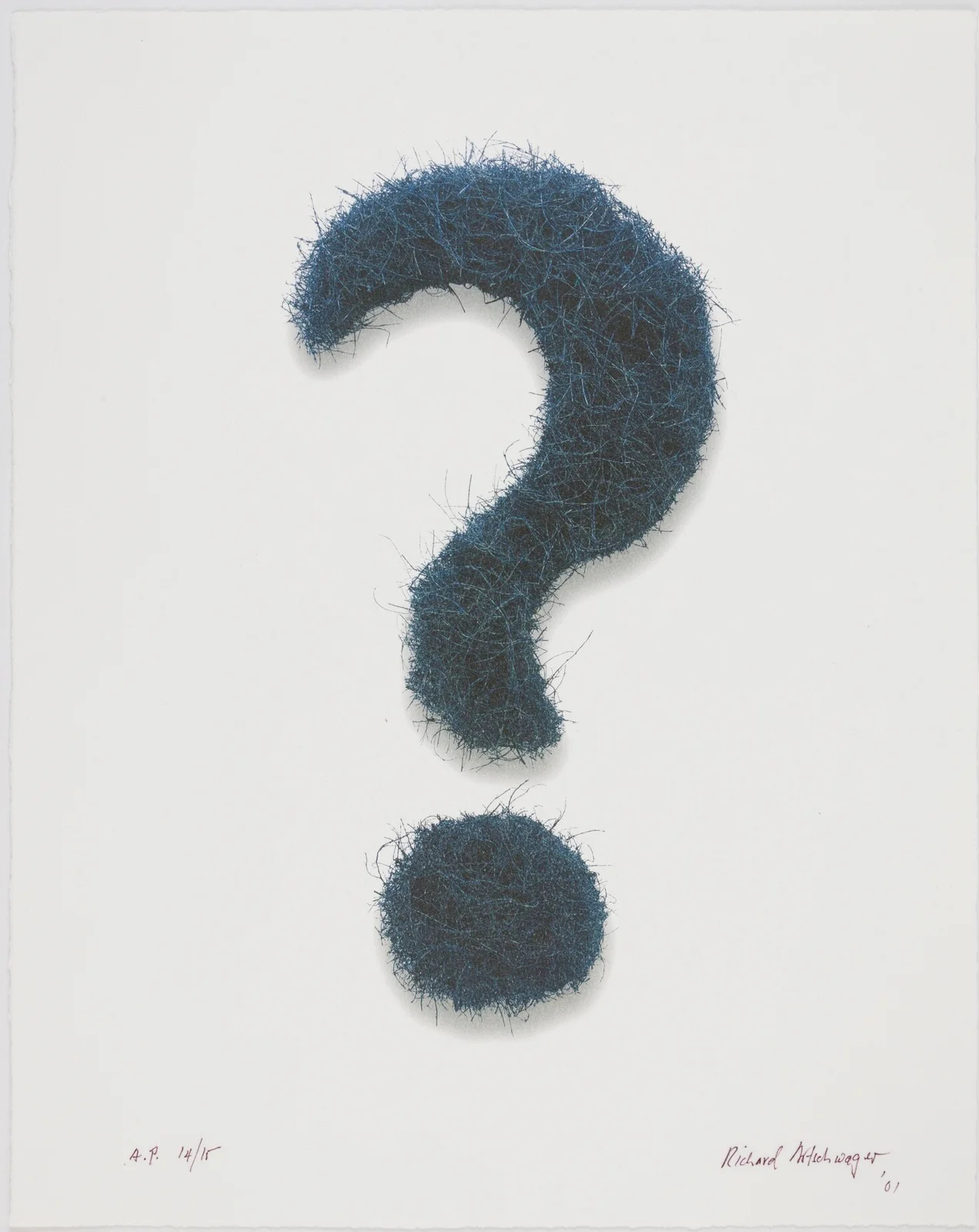
Question marks are search tools. They are fishing hooks swung upwards. We cast them into the clouds of the metaphysical realm and ask “what gives up there to make this happen down here?”
Question Mark, 2001
By Richard Artschwager
Ezekiel etched and bound two sticks. Any exiled Israelite could easily have passed him by and explained his action as the epileptic lunatic who thinks Babylon will let us return to our homeland one day. The same guy who dug a hole in the wall of his own house. Who laid on his side for ages and ate bread cooked over cow dung. The crazy guy who’s obsessed with arts and crafts.
The people who make these assumptions are not looking at art. They are looking at the outcomes of schizophrenia or PTSD or any other DSM diagnosis which used to just be called lunacy.3 They say, “That’s not art to me,” because the meaning is apparent. There is no mystery behind the actions of a crazy person.
And they are correct. Art — seeing art — requires participation. Just like a conversation.
You’ve been in those “conversations” where it isn’t a conversation. Where one person talks on and on about something and you just nod along. They stop to breathe and you try to get a word in — a question perhaps — yet they slosh the pinot grigio in their glass and roll on as if you were an answering machine. In these situations you’re not talking, you’re being “talked too.” Or talked at.
Peanuts, 1969
By Charles M. Schulz
If you recall my distinctions between art and propaganda — which is the shallowest form of artistry — you can see giving out a “talking to” is what propaganda does. It doesn’t elicit a question from you because it already has the answer. You are the fool who needs to shut up and listen.
Deep artworks — artworks which elicit the biggest questions — do not provide answers, they begin the dialog. But you, as part of the dialog, need to be involved.
We’ve all been “talked to,” and we’ve also been ignored. We’ve asked a young person about their day or their troubles and tribulations just to be met with bubble gum popping, phone scrolling, disinterested, dead eyes, followed by the grunt: “huh?”
Scott Pilgrim vs. the World, 2010
By Edgar Wright
It is a misnomer when the objects produced by artists are called ‘art’ instead of ‘artworks’. It’s like calling the first question asked at the beginning of a good discussion a discussion. The artwork is the catalyst which gets the ball rolling. It’s the moment which acts like a stubbed toe or a seductive image interrupting your day which wrangles you into an investigation.
The artistry — the real work of the artist — is the act of setting up a catalyzing object in a way so it will be seen. To frame a thing so it contrasts the backdrop of the day to day.
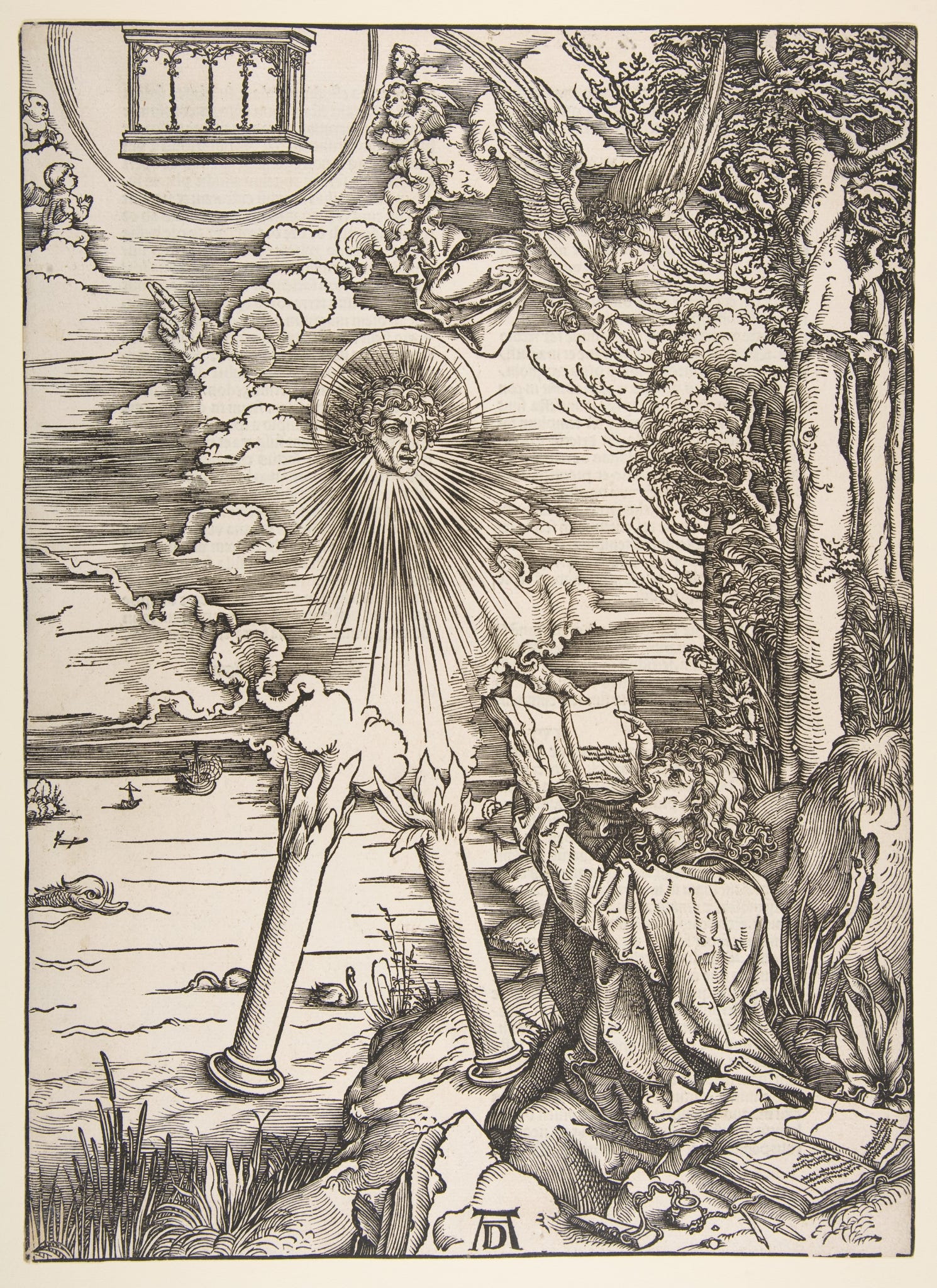
Saint John Devouring the Book, from “the Apocalypse,” 1497-98
By Albrecht Durer
The artist becomes like the prophet, he dresses differently. He speaks differently. He ties together things which don’t seem to go together. He places things as interruptions to the normal flow of traffic through the city. He stands in the way. He becomes a nuisance. He screams and yells and hollers, if the surrounding environment calls for it. Or, in a mob, he might sit still and quiet. In a garden as still as the breeze all that might be required is a rope wrapped round a stone. Why does the loudest most bombastic art originate in New York City? The artist needs to grab your attention. How do you get people’s attention in the big apple? Like this:
Midnight Cowboy, 1969
By John Schlesinger
The artist needs to work his skills so the experience we call art — the search for meaning elicited by a man made thing — might be had. (I NYC the artist must yell: “I’m arting here! I’m arting here!”)
When you glance at a Turner as you race through the massive halls of the Museum of Fine Arts Boston are you looking at art? No. The painting is simply a checkbox on your list of sights to see.
In order to experience art you have to slow down and let the questions roll into your mind like the tides and waves pulled by the moon and wind. You can see all the words of a novel by flipping through the pages but if you don’t slow down and let them weave together into a text, into a story, then you aren’t actually reading. Reading is an experience. It’s the unifying of diverse symbols — words — into a cohesive whole. This happens inside the mind which is reading.
We live in a world obsessed with objects and material, so we forget we are observers in this life. We forget reading requires a certain posture. Discussion requires a certain posture. Art, also, requires a certain posture. Our minds are more and more fragmented making us capable only of experiencing short bursts of stimuli at a time. Stimuli which are like individual units of visual calories instead of full fledged meals. We think of food as mere fuel and we think of artworks as mere communication tools.
You’re not looking at art if you’re merely admiring the composition choices. You’re not looking at art if you’re trying to determine which paintings have the best chance of increasing in value at auction. You’re not looking at art if you believe there is no meaning in this strange universe — which would mean the word meaningless is actually meaningless, which seems meaningful to me.
How do you remind people of a posture their entire culture is lulling them into forgetting?
I think you have to convince them art can help even if it seems strange or ugly or crazy. Afterall, the prophet Ezekiel was told to tell people the words from God that he received, even if he was ignored. The actions, even when ignored, were catalysts which were left inert. The artist’s job, foolish as it may be, is to make the catalyst all the same.
I believe the case for artists in an age when they garner less and less attention is similar to the exile Ezekiel faced. Many will pass by, but a remnant will stop and ask, “what does this mean?”
Can’t Help Myself, 2016
By Sun Yuan and Peng Yu
“One must imagine Sisyphus happy” - Albert Camus
There is more to be drawn from this, especially if you dig deeper into Israel’s history. Suffice to say, it has depth, but it begins in the shallow end of the pool.
Yes, they can point to stupid things in the shallow end or interesting mysteries in the deepest of depths.
Moon mad. The mind has fallen under the influence of the waxing and waning secondary light which fluxes through the night.
I was just doing some research on what percentage of people engage art versus make art. Makers are in the single digits. Which means most people are viewers or consumers. There are millions of people to produce for. Even if they don’t enjoy what you are making.