


Sometimes I encounter a work of art which resonates with my own work — and I am filled with joy. Then, envy. I wish I had thought of such a beautiful piece. This week I experience this “joyenvy”:
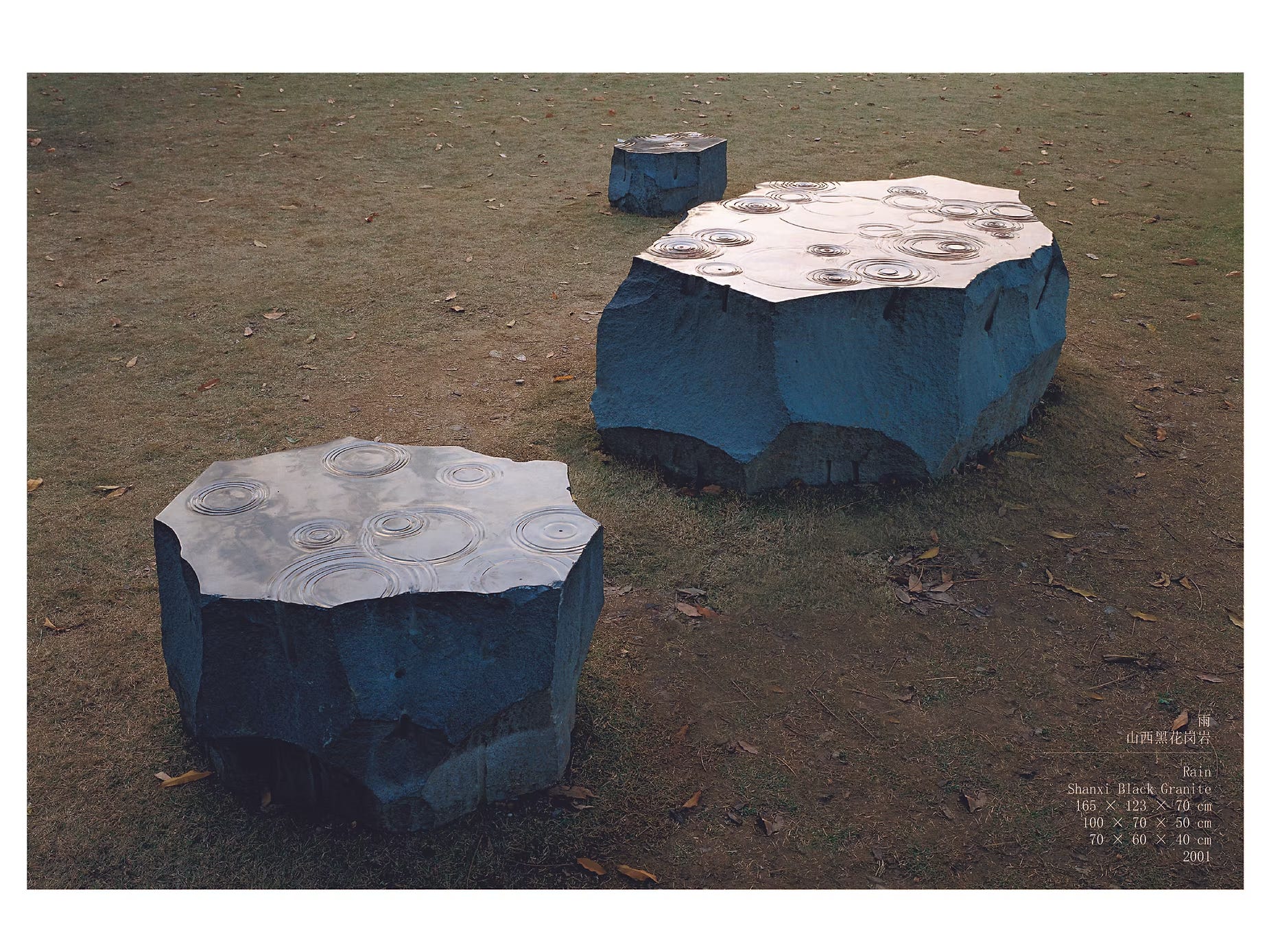
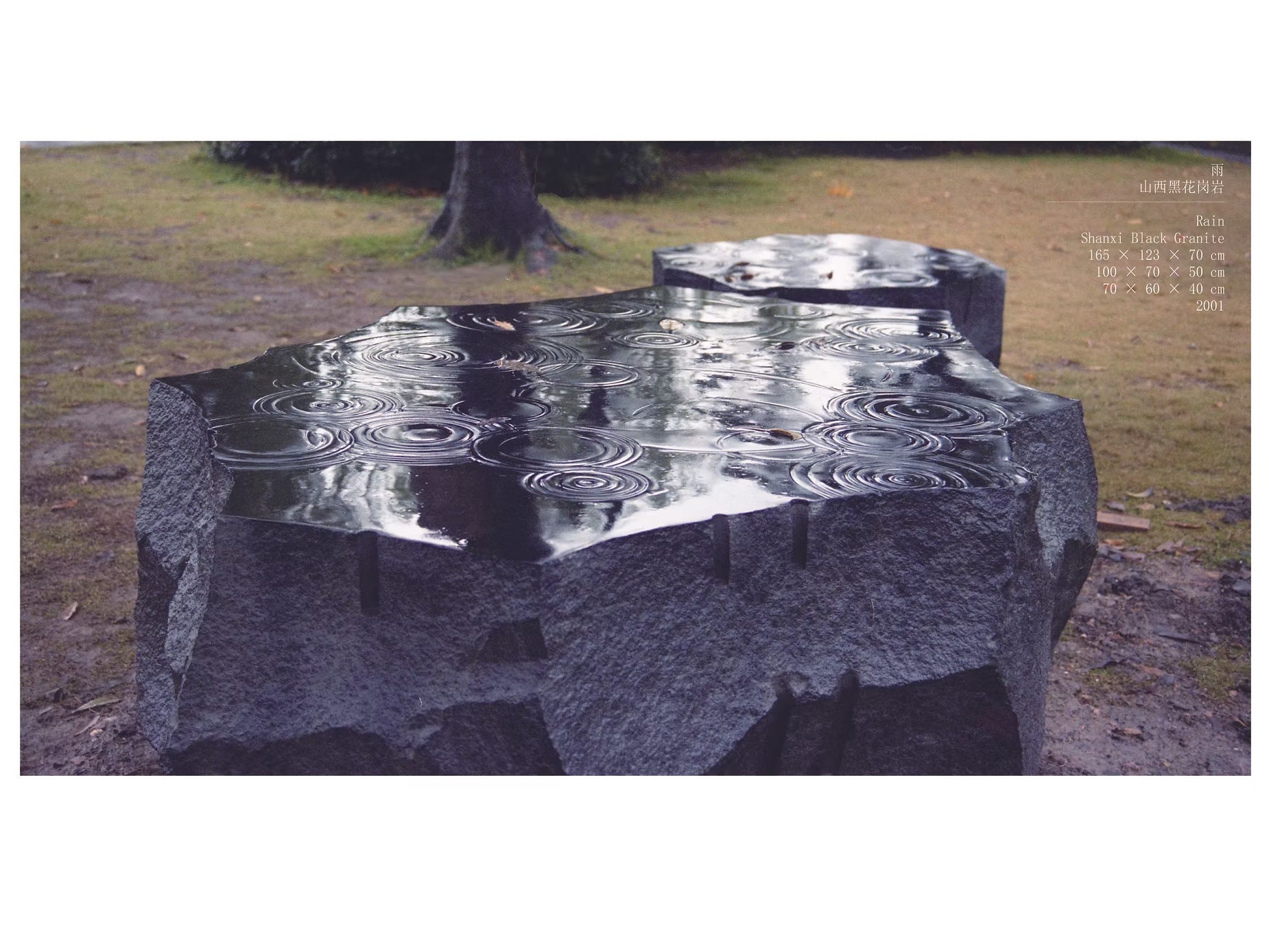
These are not wet stones. In fact, if you notice the ground, this is not a rainy day. Shen carved and polished the surface of these stones so they appear as though rain is rippling their surface.
When I began drawing stones and mountains a few years ago I had a poetic intuition: If I could watch a single stone for a billion years I would see it flow like water.
Stones are solid only when seen from the perspective of our lifespans. Iain McGilchrist referred to the great mountain behind where he grew up as “a very slowly crashing wave.”
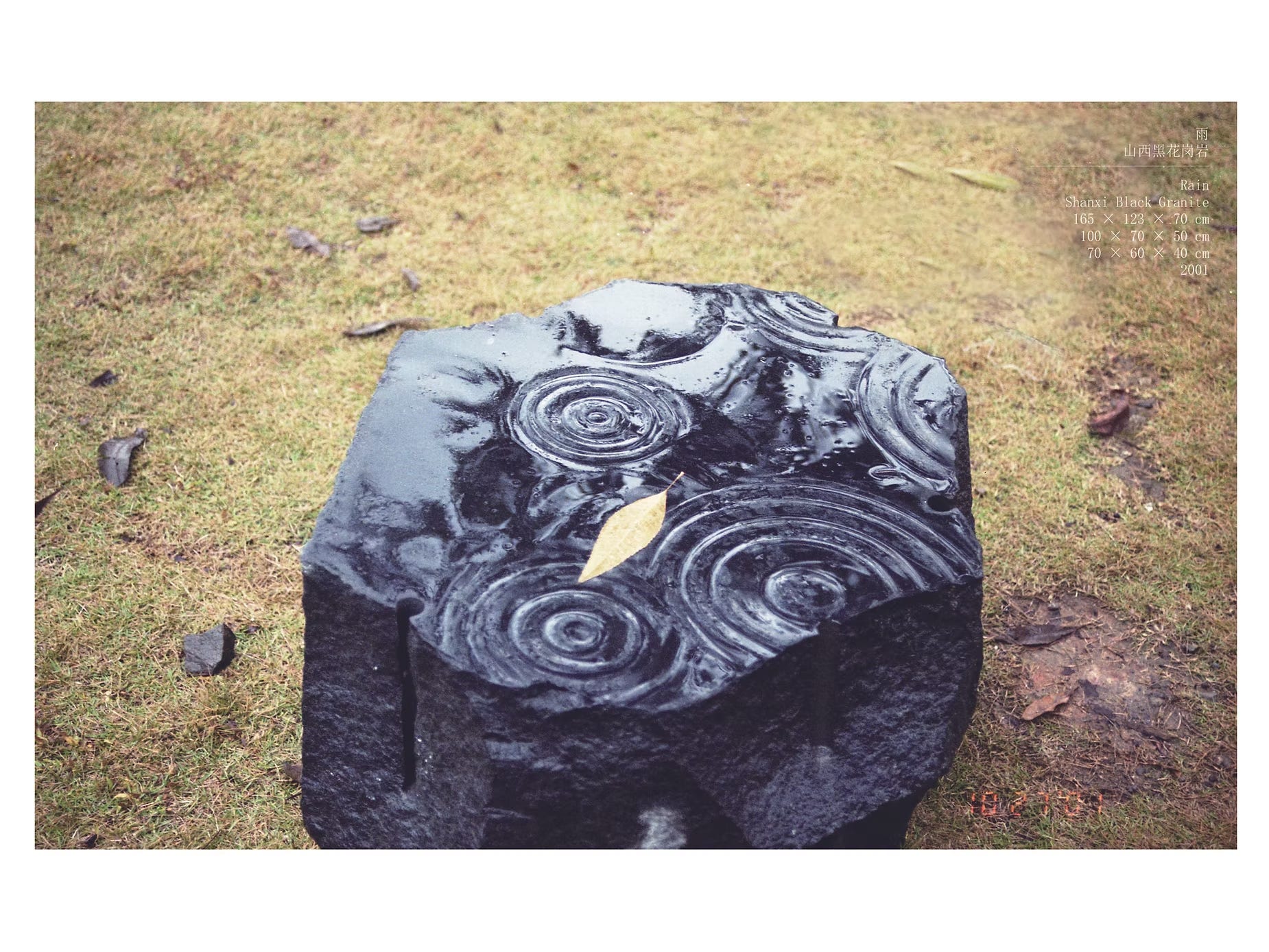
The simplicity of this illusion is a wonder. Like the rabbit/duck illusion I keep bouncing between seeing stone, then water, then stone. I know it’s all stone. But the frozen surface, polished so well, has the same effect as looking at the surface of water. Getting lost in the well of contemplation which dark rippling water hypnotically induces.
Rain, 2016
By Shen Lie-Yi
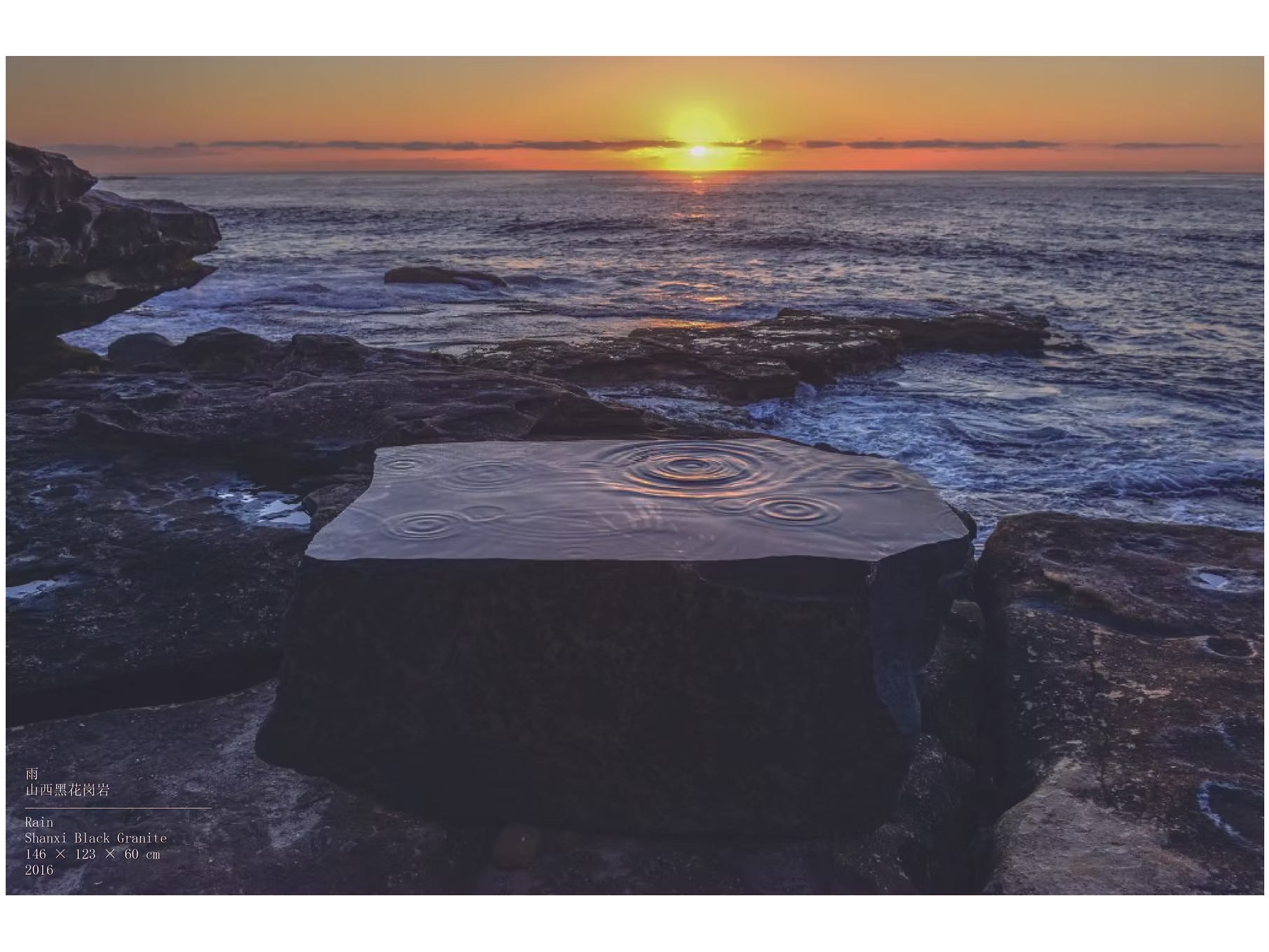
All of these illusory pieces remind me of the primal connection between water and stone. In Shen’s own words the connection of these two opposite mediums holds cosmic significance:
“Using rough granite to express the elegance and peace of water is the challenge of fusing two extremes within one medium… In traditional Chinese culture, water symbolises the principle of yin and softness, while stone symbolises yang and hardness. One of the rich insights of Daoism is that ‘hardness and softness compensate for each other’.”
In my own religious tradition stone and water are deeply connected as well: Christ is the rock, the corner stone, the stumbling stone. Yet Christ is also the spring of life. In the creation account, dry land (stones) are separated out of the primordial waters. Moses after raining plagues on Egypt, crosses through the Red Sea, then twice makes water spring from rocks in the desert.
If rocks have minds — after all, Christ says rocks can cry out and the standing stones set up by the Israelites were “witnesses” to what God had done for them in the desert — then they are the sort of minds which are accustomed to patience.1 Their “lives” — from formation, deep within the crushing crust of Earth, their surfacing, their sitting around, and final end — might be punctuated by moments of use or reshaping by the hands of humans, but largely consist of sitting and waiting. A lucky stone might end up in a cathedral or garden path. Most will be ground down as gravel or might spend their entire lives slowly turning into sand by unending waves of water rocking them back and forth in a pebbly cradle.
The slow formation returns every rock to dust. One day all rocks will make their way back to the magma deep within the earth. Their solidity will be transformed back into a fluid.
—
This is all very poetic. But what does it mean? Everything decomposes and is reconstituted in some manner. Even Shen sees fluidity in more than rocks:
Rain, 2011
By Shen Lie-Yi
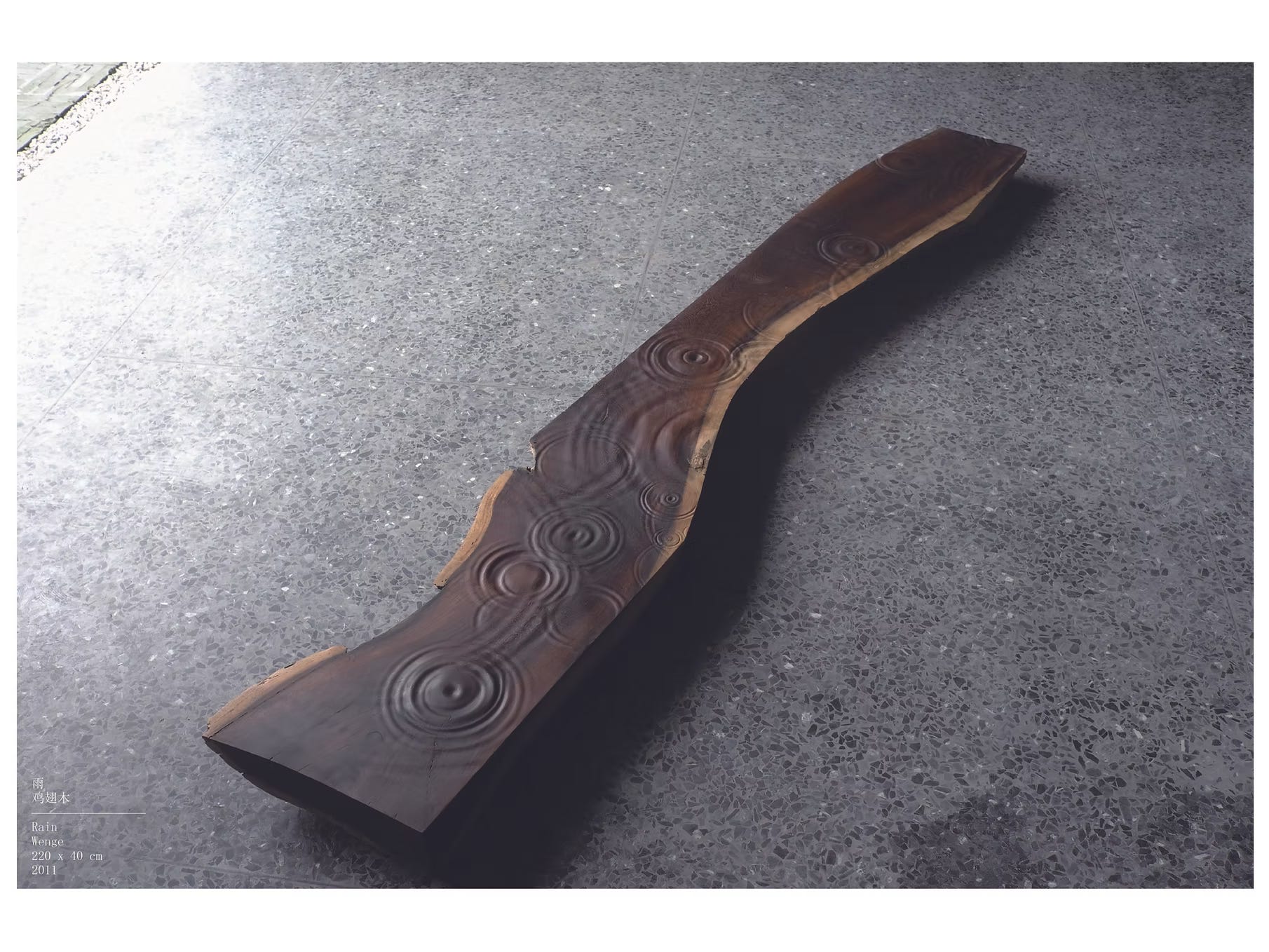
Shen’s work embodies the truer perspective of our world, a perspective which is not readily apparent in our short 85ish years. It’s a billion year perspective which says “even this stone is a ripple on the surface of water.” If a human life is “but a breath,” and a stone is a raindrop cascading through creation, then all things will pass. This world is beautifully and graciously ephemeral.
David Whyte says it well (you can simply replace the word poet with artist):
The Poet
By David Whyte

moves forward
to that edge
but lives sensibly,

through the senses
not because of them.

Above all he watches
where he steps.
As if it matters
where he leaves his prints.

The senses overwhelm him
at his peril.

Though he must be taken
by something greater.
That is what he uses
senses to perceive.

The poet's

task is simple.
He looks for quiet,
and speaks to what
he finds there.

But like Blake
in his engraving shop, works
with the fierceness
of acid on metal.

Melting apparent
surfaces away
and displaying
the infinite
which was hid.

In the early morning
he listens
by the window,
makes
the first utterance
and tries to overhear
himself
say something,
from which
in that silence,
it is impossible to retreat.
—
Our world is not awaiting crystalized perfection. It is not waiting for all things to be put in their proper place, like a museum display case. Our world is living, moving, ever changing, ever growing, ever flowing. It is “new every morning.”
Shen, like Blake’s acid, melted away the apparent surface of the granite to display the infinite changing creativity of God which is hidden inside every stone. These artworks are springs of living water bubbling up to the surface for our eyes to drink. God didn’t make creation and step away. God is still making all of creation, even the stones flowing beneath the foundation of your house.
I think the patience a stone must have is one of the primary reasons why Christ is a rock. His patience with me… well… it’s monolithic.
How stunning! This so captures the sacramental act of the poetic artist, bodying forth the unseen and offering that unveiling as a collective act of recognition and appreciation. I love the reflection on stones and their purpose in the theodrama, even. Something that otherwise seems so static when our perception is limited to the timeline of our lifetime, has dynamic relation when considered in the long outstretched obedience of creation moving in a direction. I love it, my friend.
This is really cool and I love thinking about a mountain as a really slow crashing wave. I once had a similar idea for the front of a bourbon cabinet - carved water drop waves that blend together. Bourbon is best shared, and in sharing people weave together to become a self. I thought it would be cool to physically symbolize that in the front of the cabinet and water drops is what I thought of. Someday I’ll make one. Maybe.