


Right now I am asking, “why is Lent so long?”
It’s not a week or a month. It’s not four weeks or seven. It’s forty days. Except, Sundays. Sundays break it up with a festive pause. Then there is Holy Week which is like Super-Lent. But Lent itself, apart from Sundays, is 40 days long. Why?
Well, Jesus was in the desert for 40 days:
Christ in the Desert, 1872
by Ivan Kramskoi
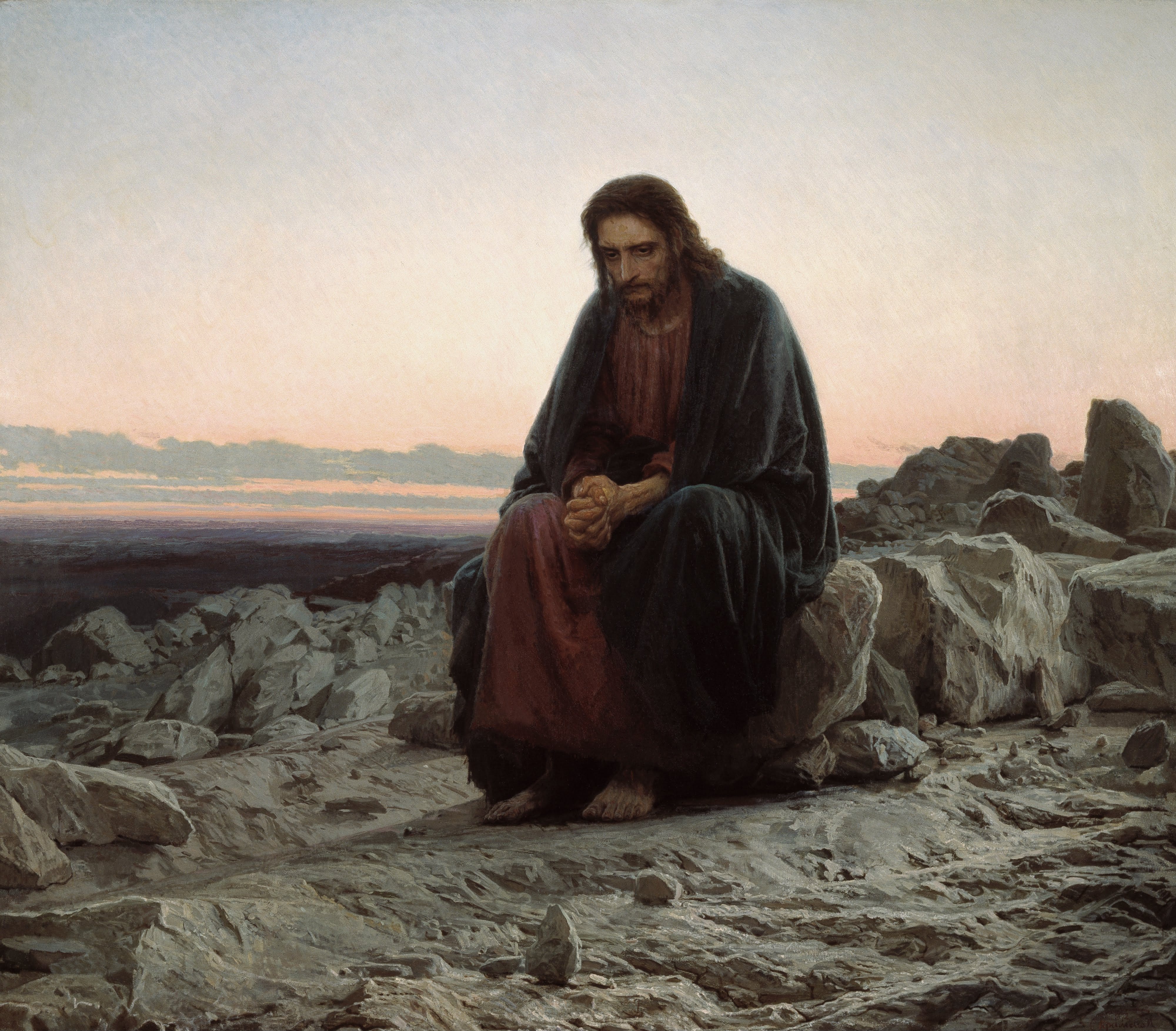
Forty days and forty nights with no food in the desert. I love how Kramskoi liters the landscape with stones which will be used by the devil to tempt Jesus. Apparently after forty days even stones start smelling like baked bread.
But, why was Christ in the desert for 40 days? (Obviously, I was never an annoying child repeatedly asking: “Why?”)
The 40 days reflects the 40 years the Israelites spent wandering the desert. And the 40 days of Noah’s flood. Still, why all the 40s?
It has something to do with this poem:
I live my life in widening circles
by Rainer Maria Rilke
trans. Anita Barrows and Joanna Macy

I live my life in widening circles
that reach out across the world.
I may not ever complete the last one,
but I give myself to it.

I circle around God, that primordial tower.
I have been circling for thousands of years,
and I still don't know: am I a falcon,
a storm, or a great song?
Circles are the key to understanding the ancient symbolism of numbers and the reason why the number 40 occurs over and over. Circles are primordial, more so than squares or triangles. Why? (There I go again.)
Go stand on a mountain top and what do you see? You spin in a circle and see the world as a circular disc. Observe the Sun and Moon, they look like circles, and what do they do? Go in a circle. In the words of the great scholar, sage, and jokester James Acaster, “My eyes are circles.” We see circles everywhere: wedding rings, kings crowns, black holes, wheels, and, as Acaster said: pupils.
Circles have always had sacred significance. In fact, there is a whole movement of thinkers trying to define what they call “Sacred Geometry,” which uses a circle as the foundation from which all the other shapes unfold:
Liber Divinorum Operum, 1165
by Hildegard von Bingen
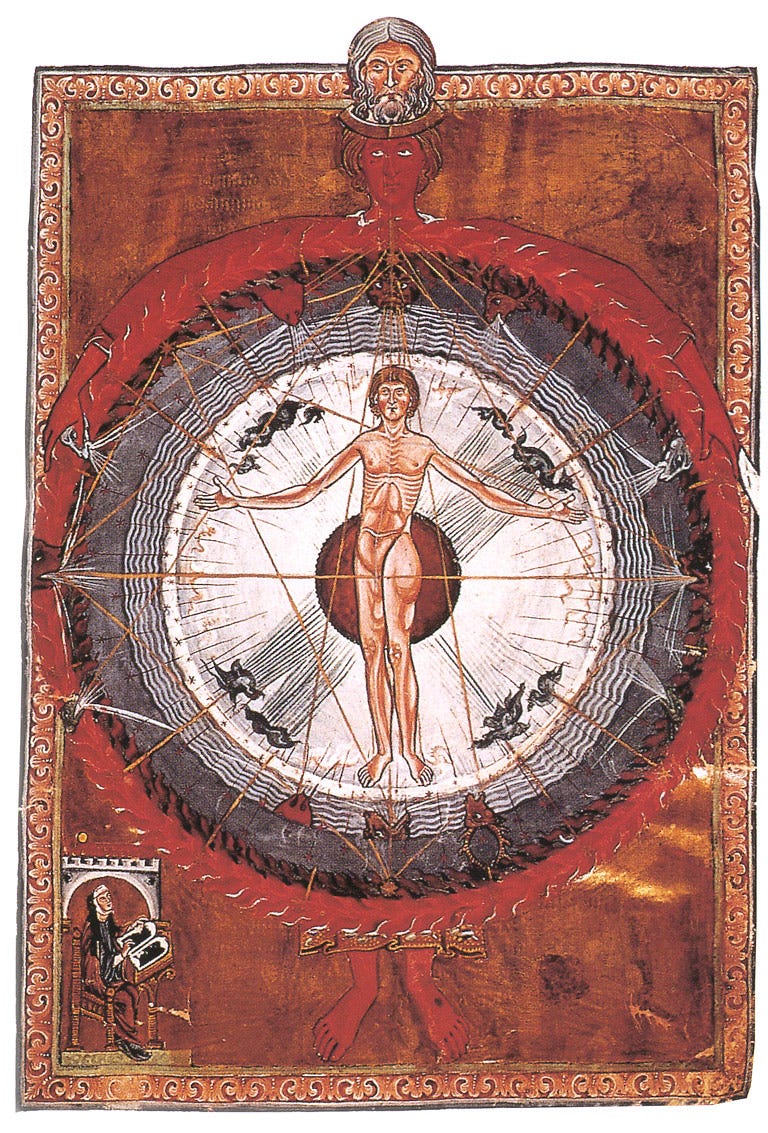
There is to much under the banner of Sacred Geometry to unpack here so let me focus on the where the 40 comes in.
Plunge a stick into the sand on the beach. Tie a string to it with a loose loop that slides so the string does not wrap itself around the stick. Tie a second loop on the other end of the string and place another stick, or your finger, in the loop. Draw a circle by swiping it all the way around the center stick (just like the horizon line around you when you were atop the mountain earlier).
Now, take the string (in geometry terms this is the radius of the circle) and start counting how many times it wraps around the edge of the circle (the circumference). It will always be the same: just over six — not quite seven — times.
If the world is made of circles how do you divvy up time to make it more workable? Start with the circle. Six full days with one as a remainder. Remind you of anything? The Jewish notion of a week: six days to work and one day to rest. The remainder, the incomplete seventh section is set aside for the Sabbath.
Should everything be divided into sevenths like a circle? Well the Moon throws this for a loop since it finishes twelve cycles1 for every one of the Sun’s cycles but what other things can be divided up into sevenths?
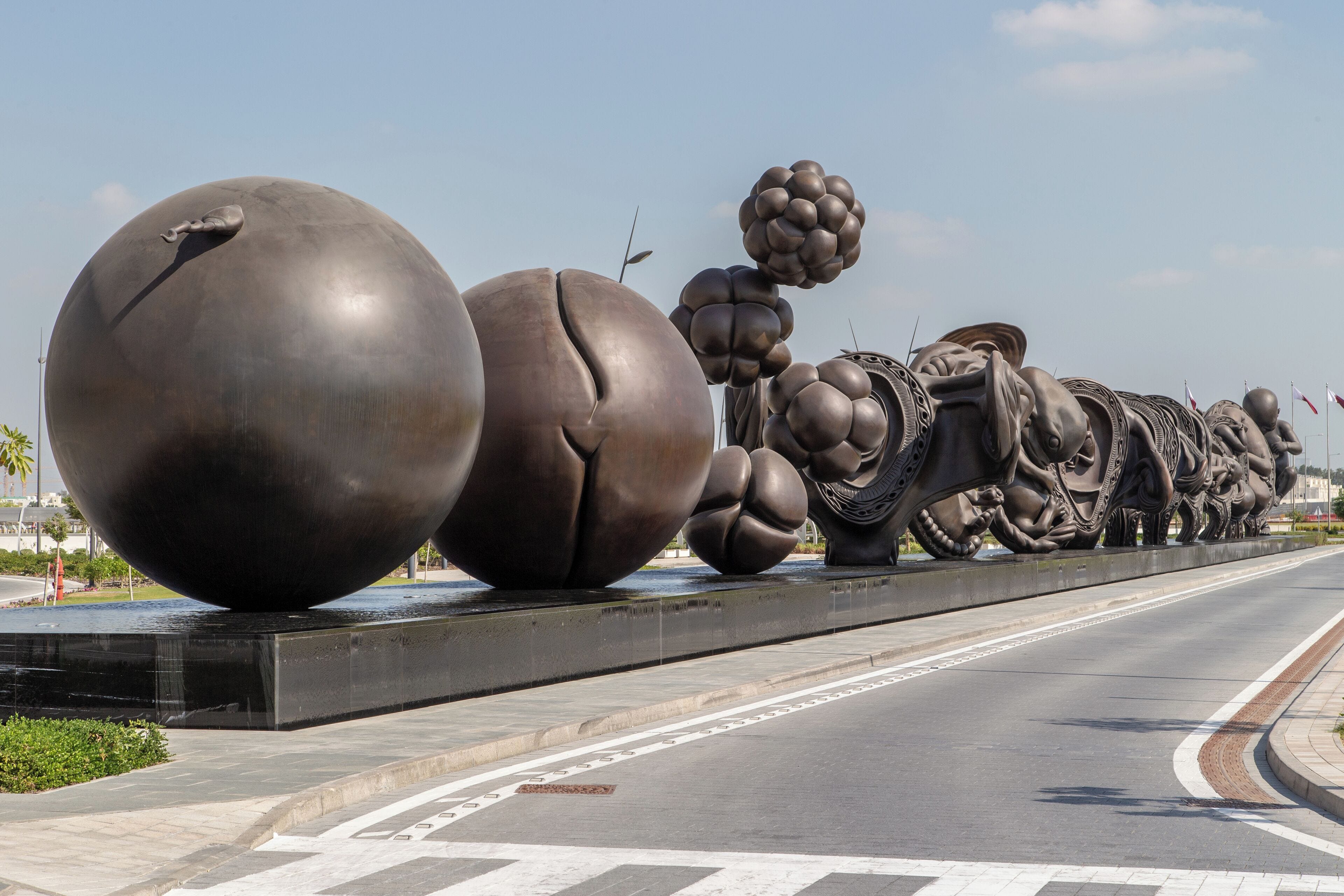
This:
This series of sculptures by Damien Hirst are title The Miraculous Journey. The average pregnancy lasts around 280 days, give or take. If you divide 280 by 7 you get 40. What about the give or take? Remember how the seventh section of the circle is a remainder? The remainder is where divine wiggle room comes in: the last day might be a bit short or a bit long.
If we think of pregnancy as a circle (broken up into 7 parts), then 40 calendar days makes up one day in the “week” of pregnancy. It might be odd, but it is human. Just like these sculptures are odd, but human.
One of the reasons I like the Imperial system of measurements over the Metric system is because of how many human elements are baked into it.2 If you are a man, take your thumb and measure your bare foot from heel to toe with the width of your thumb’s knuckle. It will be about 12 thumb widths. A foot. Take a stride and you will see about three feet fit between your two feet from toe to toe. These are human measurements.
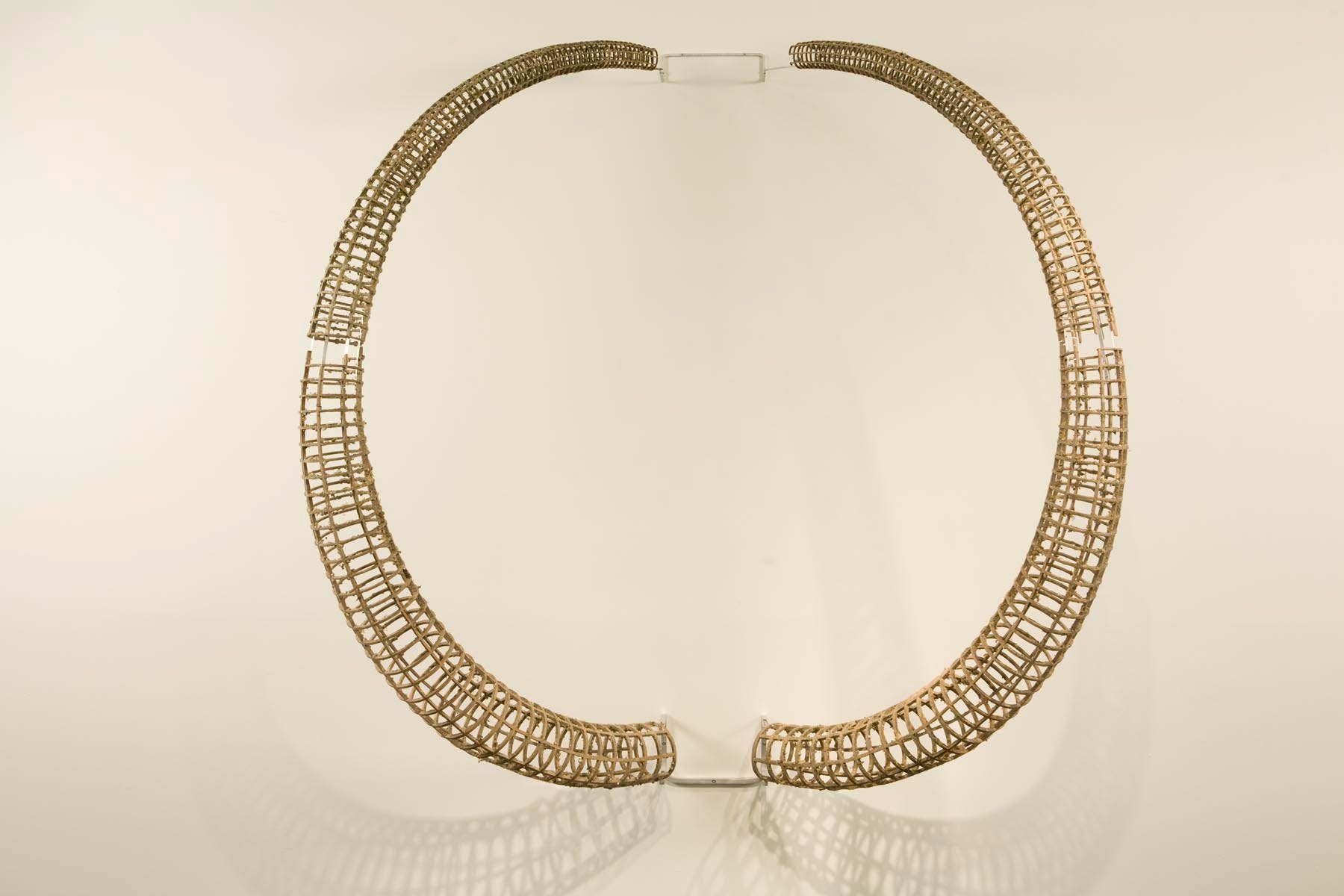
40 days is a very human measurement of time — it’s a day in the week of your birth. There are other types of measurements, specifically I am reminded of nature’s time. John Grade collaborates with nature’s time through his art:
Collector, 2006-08
by John Grade
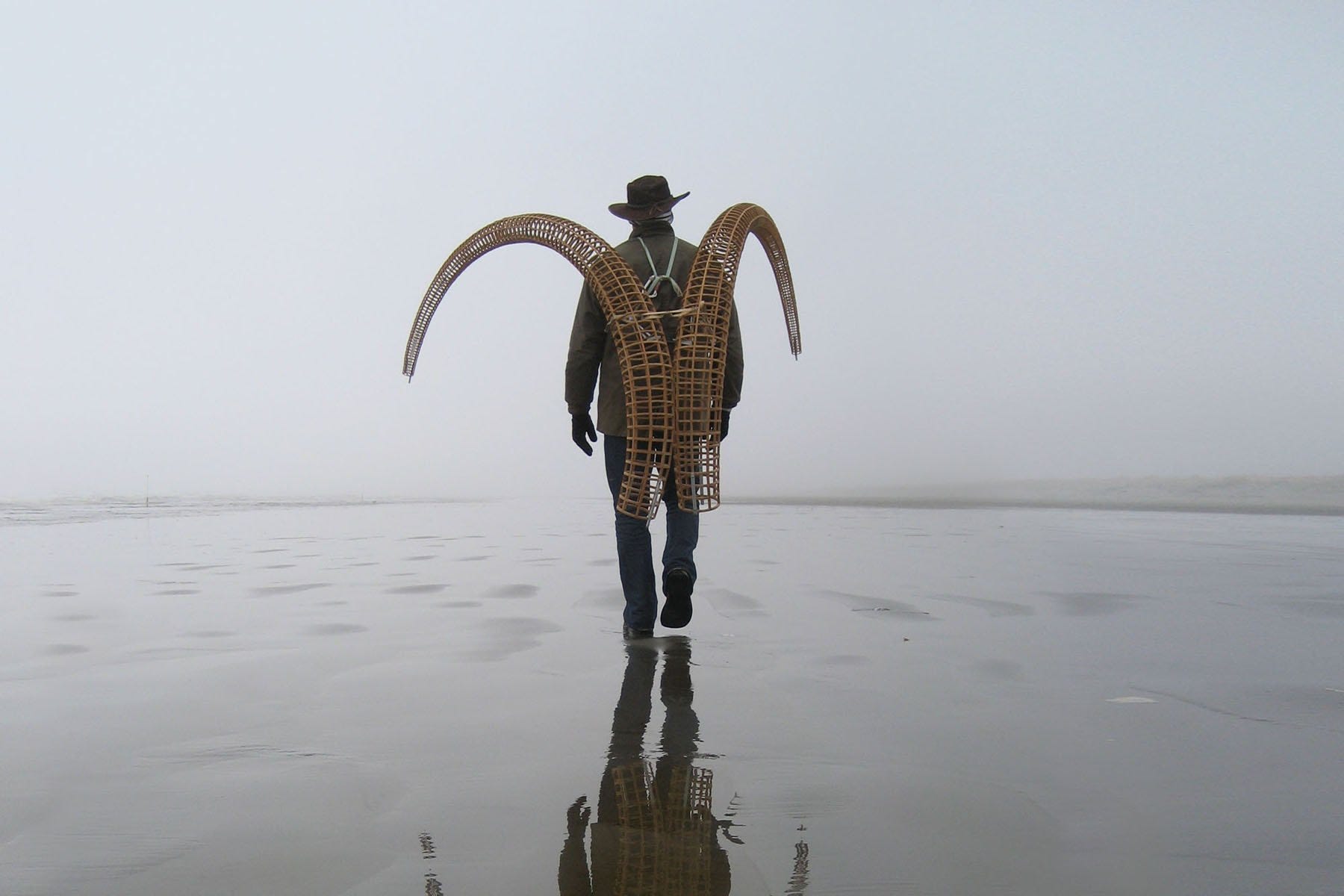
Grade constructed a split circle of wooden lattice which he carried out into a variety of wildernesses and left it to weather the elements. He submitted it to the seasons and patterns of nature. It was submerged in water:
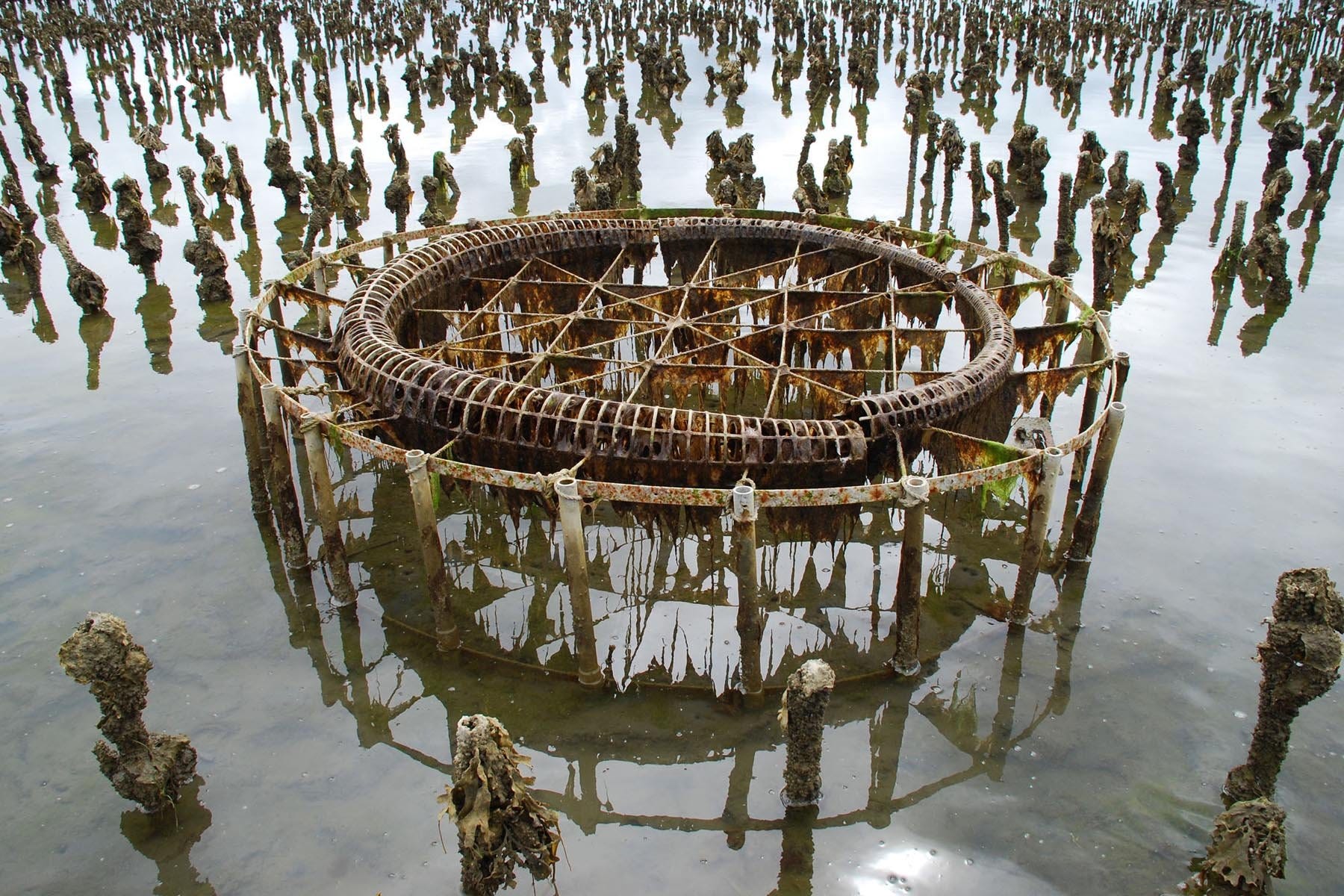
It was dried in desert winds:
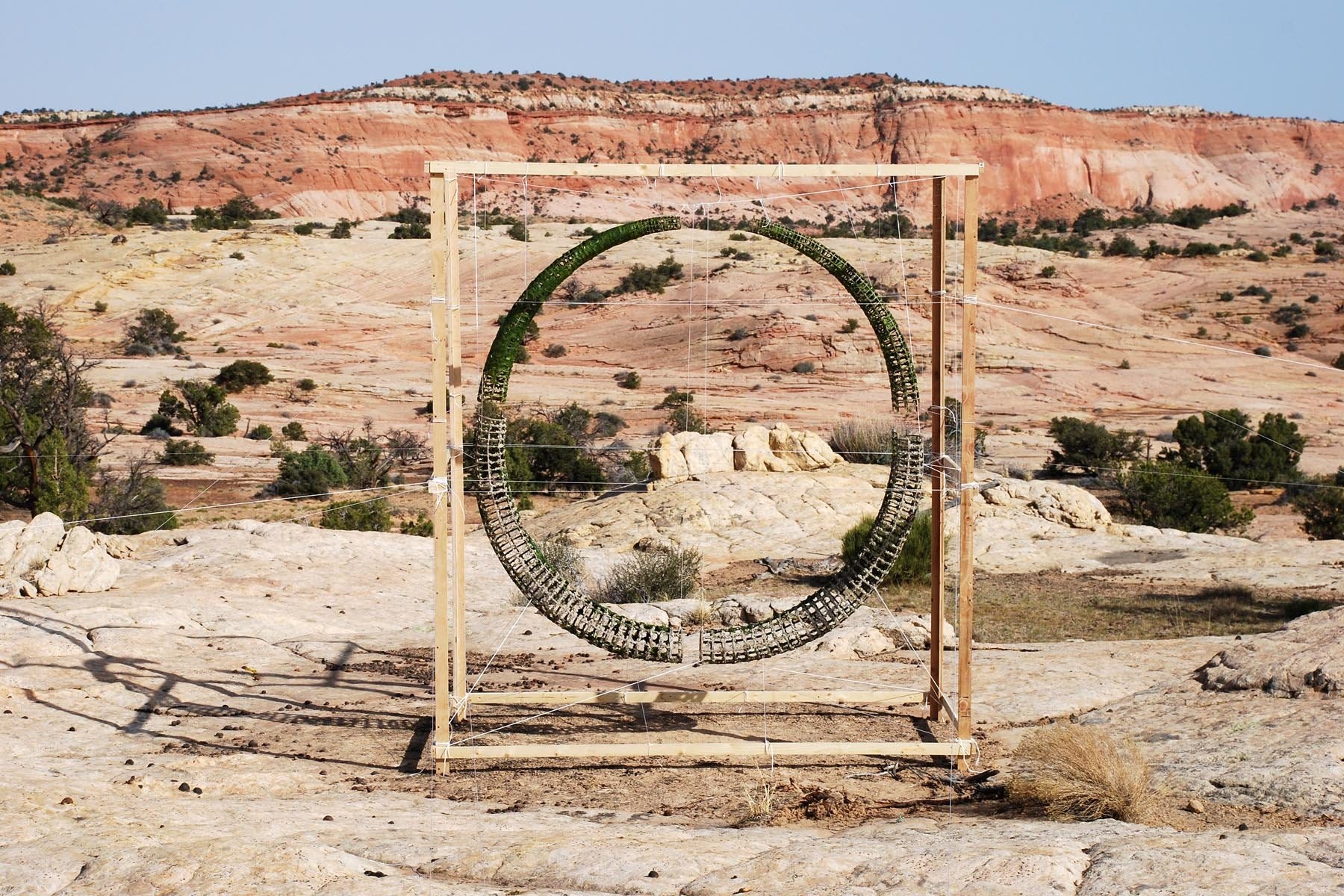
As it hung on the mesa, desert wrens ate the seafood encrusted to it like mana.
Throughout its journey it collected bugs, crustaceans, and bird poop. It was scoured by sun, water, and wind. It was strapped to his back. It was strapped to his truck. It was placed in a ravine. It became a dry and crusty thing when it was finally placed in a gallery:
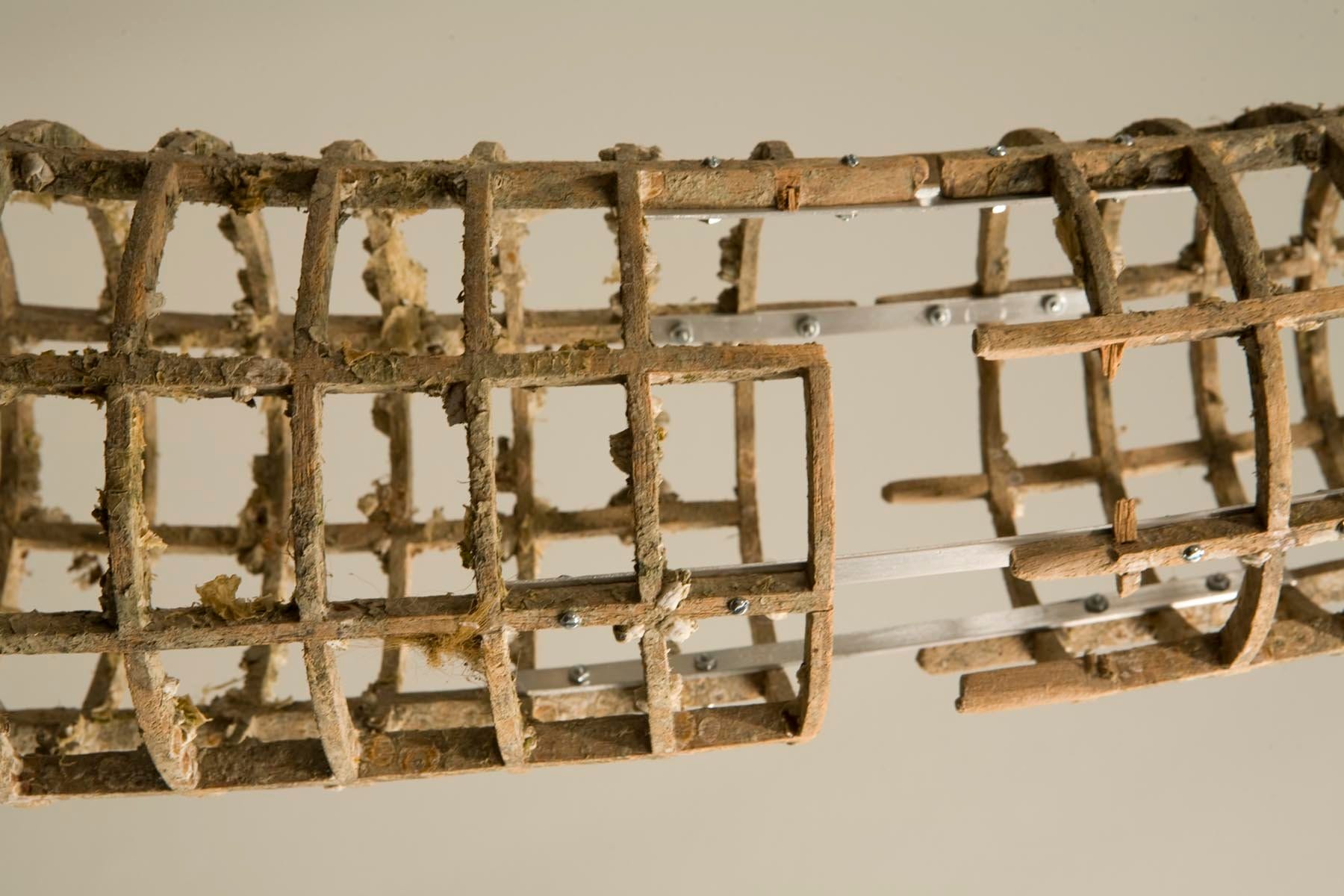
Like old hands that bear the cracks and calluses of years, the sculpture has lived at the speed of nature.
Regardless of how we measure time I think Rilke is right about the shape of our lives. Perhaps we could adjust the poem to say, “We live our lives in widening circles / that reach out across the world.”
But we do not circle one thing. We are more like a cluster of circles circling the center “primordial tower.” Rilke sees himself as a bird, a swirl of storm clouds, or the notes of a song. I imagine our circling like orbiting planets. As we orbit the God center of our lives, other things join our orbit. Your spouse may become a tidally locked moon. Or your job may pull you to one pole, off from the center.
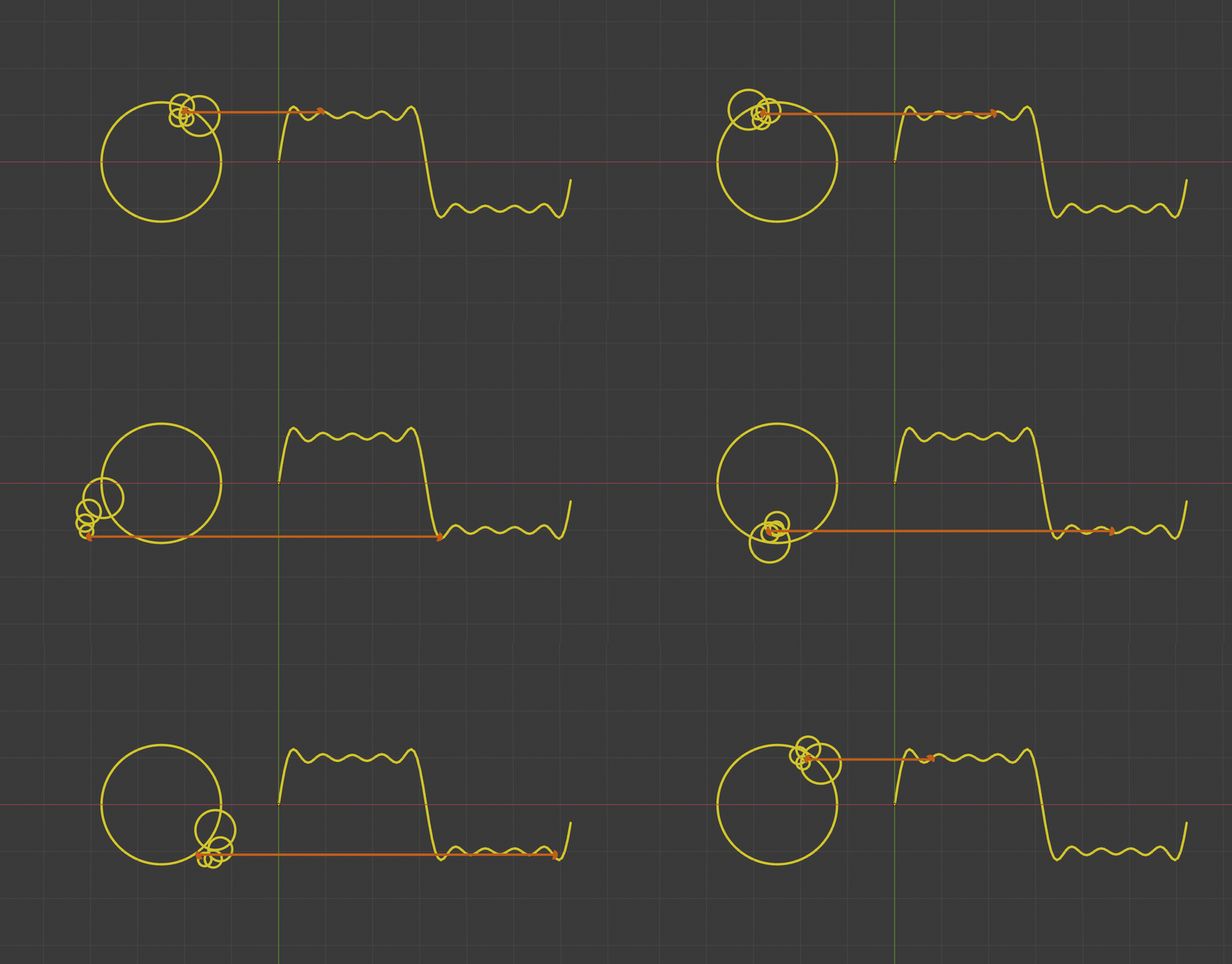
We are moving, rotating, Fourier Series.3 This series of drawings is made by using only circling circles, which then make a strange orbit as seen in this gif:
The refocusing of Lent, the deprivation I wrote about last week, helps us shed some of our other orbits. It refreshes our path so we circle God, the center of our lives, with less turbulence. The length of Lenten time, 40 days, allows us to grow.
After all, 40 days is linked to gestation. Lent is long enough for the impact of the disciplines to remain, if not for a whole year, then for the majority of this cycle round the sun.
We are collectors of many orbits and gravitational pulls. Some of which make the arc of our lives more beautiful. Some which throw us off from the center. You might be leathery and desiccated at the end of your life, like John Grade’s sculpture. Lent is the time in the desert where the birds pick the crustaceans away. The day of growth through pruning. Lent will reduce the drag on your circular orbit and you will draw closer to the middle this time around.
Collector, 2006-08
by John Grade
This is why there are twelve tribes of Israel and twelve apostles. It’s those pesky bakers who are ignoring the nobility of our cosmic night light who have thrown our dozens into disarray.
It’s true Imperial measurements are generally related to the male body instead of the female body.
Checkout this video by Destin at Smarter Every Day for a better understanding of how a Fourier Series works: