


New Year’s Eve feels a bit artificial. Growing up in SoCal the seasons were more subtle (read: essentially non-existent) and time felt disconnected from the movements of the Earth. Aside from fireworks in the evening, the day felt just the same as any other. The mundanity of this poem resonates with me:
To the Garbage Collectors in Bloomington, Indiana, the First Pickup of the New Year
By Philip Appleman

(the way bed is in winter, like an aproned lap,
    like furry mittens,
    like childhood crouching under tables)
The Ninth Day of Xmas, in the morning black
outside our window: clattering cans, the whir
of a hopper, shouts, a whistle, move on ...
I see them in my warm imagination
the way I’ll see them later in the cold,
heaving the huge cans and running
(running!) to the next house on the street.

My vestiges of muscle stir
uneasily in their percale cocoon:
what moves those men out there, what
drives them running to the next house and the next?
Halfway back to dream, I speculate:
The Social Weal? “Let’s make good old
    Bloomington a cleaner place
    to live in—right, men? Hup, tha!”
Healthy Competition? “Come on, boys,
    let’s burn up that route today and beat those dudes
    on truck thirteen!”
Enlightened Self-Interest? “Another can,
    another dollar—don’t slow down, Mac, I’m puttin’
    three kids through Princeton?”
Or something else?
Terror?

A half hour later, dawn comes edging over
Clark Street: layers of color, laid out like
a flattened rainbow—red, then yellow, green,
and over that the black-and-blue of night
still hanging on. Clark Street maples wave
their silhouettes against the red, and through
the twiggy trees, I see a solid chunk
of garbage truck, and stick-figures of men,
like windup toys, tossing little cans—
and running.

All day they’ll go like that, till dark again,
and all day, people fussing at their desks,
at hot stoves, at machines, will jettison
tin cans, bare evergreens, damp Kleenex, all
things that are Caesar’s.

O garbage men,
the New Year greets you like the Old;
after this first run you too may rest
in beds like great warm aproned laps
and know that people everywhere have faith:
putting from them all things of this world,
they confidently bide your second coming.
Despite the change of the year, trash will keep getting picked up. The only difference seems to be in our minds if we look around us. But there is a change the Gregorian Calendar reflects with the beginning of a new year that is not noticeable here on the ground; the days are getting longer. No, the new year does not correspond with the shortest day of the year — the winter solstice — but it comes close after, at least in the Northern Hemisphere.
It’s as if we are all slumbering bears hibernating through winter who have just snored ourselves awake to realize the cold cold days are getting just a bit longer. So we pop some champagne and resolve to change before we curl back up in our caves. Even though we might return to our cozy dens the days are getting longer and we can see the evidence of a coming spring.
Nancy Holt’s Sun Tunnels mark this change well:
Sun Tunnels, 1973-76
by Nancy Holt
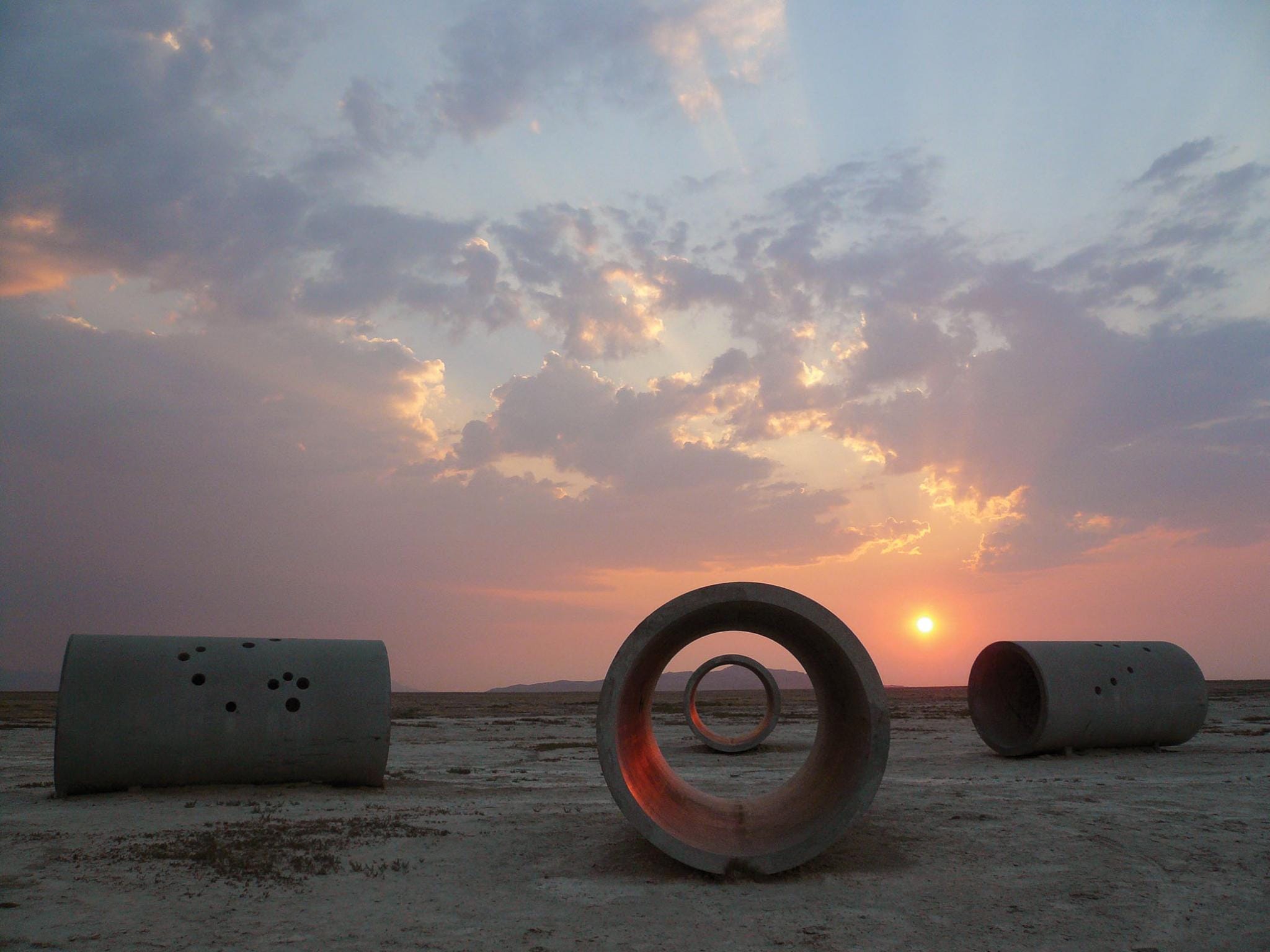
Two sets of concrete tubes criss cross in the Utah desert. Each pairs aligns with the rising and setting sun on both the shortest and longest days of the year. The sun slips back and forth from one extreme angle to the other. At the new year acknowledge that your space ship of a planet has wobbled its way round so that the sun is headed back north. Happy the new year, may each day be new!