


I’ve been reading a lot of Eugene Peterson’s writings recently in correlation with a large-scale commission I’m working on. This quote from Peterson’s book Reverse Thunder keeps returning to my mind:
“A poet uses words not to explain something, and not to describe something, but to make something. Poet (poētēs) means “maker” Poetry is not the language of objective explanation but the language of imagination. It makes an image of reality in such a way as to invite our participation in it. We do not have more information after we read a poem, we have more experience. It is not ‘an examination of what happens but an immersion in what happens.’”
I think we can replace the word poet with artist — or, even better, expand the word to include artists of all mediums. “Makers” are not saying things so much as making things for interaction, for “participation.” Understanding artworks as invitations for participation, leads to Peterson’s key insight: “We do not have more information after we read a poem, we have more experience.”
This is such an important distinction which can help us understand how to participate with a work of art.
Imagine a life changing event, positive or negative; a birth, a death, a proposal, a party, an accomplishment, any experience which changed your life.
Imagine it as a movie playing in a room. Then, imagine a friend coming into the room to view this film. This work of art.
How would you feel if their first response, after viewing the memory-made-film, was “what are you trying to say?”
Recounting the memory in this form is not about saying something. It’s about sharing the life experience with another so they might participate, so they might have a sense — albeit an artificial sense — of what the experience was like.
The film might end up saying a variety of things to all manner of audience members but the reason to share such a thing was not to communicate a message first. The message comes after, in the dialog an audience has with the artist or with the experiences of life mixing with the experience of the artwork.
This is also how we wrestle with our own memories in a therapeutic setting. We reminisce and think, “why did this happen to me?” Within a few minutes of our head resting on the psychiatrist’s couch we wonder, “what did this event mean?” Which does not imply our past had a message for us. It implies our past experiences changed us. They impacted us. Or as Peterson says of a poem, “It is not ‘an examination of what happens but an immersion in what happens.’”
Presenting a memory-film for “examination” is the same as watching a self-help video. An expert recounts the actions and steps they took to gain success so you might take the same steps and achieve the same success. Or, conversely, avoid the same mistakes. [It’s hard for me to ignore the reality of how often this sort of instruction doesn’t result in the same degrees of success for those who follow the paths laid out by gurus.] Presenting the memory-film with the hope of “immersion” is like watching a great movie. A movie where the audience is engrossed in the story. They want to know what happens next. When it’s over, they lean back and ponder all the twists and turns of what unfolded.
They ruminate upon the experience. They might ask, “what did I just see?” which will lead them to ask, “what events in my life, does this remind me of?” which might finally get them to ask, “what does this mean for me?” The experience does lead to a message of sorts, but it’s a contextual message. It’s the message the person receives after they have experienced the film and connect it with their own life. A distracted viewer, one whose scrolling on the apps, neither experiences the film nor has any sense of how it might mean something.
Great works of art are so dense with experience the pondering never ends. There is more to be overturned and re-experienced. As the audience ages and is able to draw upon more life experience, there are more and more layers of reminders, and therefore meaning, in great works of art.
Pondering this Peterson quote has me wanting to return to artworks a second time. So, today I turn back to two pieces I have chewed on for a long while. The first I have not yet written about. The second, Monet’s Waterlilies, was the basis for naming my post categories Fragments, Reflections, and Depths.
Praise In Summer
by Richard Wilbur

Obscurely yet most surely called to praise,
As sometimes summer calls us all, I said
The hills are heavens full of branching ways
Where star-nosed moles fly overhead the dead;
I said the trees are mines in air, I said
See how the sparrow burrows in the sky!
And then I wondered why this mad instead
Perverts our praise to uncreation, why
Such savour's in this wrenching things awry.
Does sense so stale that it must needs derange
The world to know it? To a praiseful eye
Should it not be enough of fresh and strange
That trees grow green, and moles can course in clay,
And sparrows sweep the ceiling of our day?
Wilbur’s poem can be a bit hard to understand because of the older language. Let me try to break it down, then go back and read it again:
In the first two lines the poet is telling us his posture toward the world. He feels called to praise God for the beauty of the world but he cannot do so in a straightforward manner. Hence, starting with the adverb “obscurely.”
The third line is the beginning of this obscure praise he finds within creation. What is the nature of this obscure vision? He turns the world upside down. The hills (earth) is heaven. Moles are flying instead of digging. The tree’s branches are like mine shafts snaking beneath the surface of the earth, but instead he sees them in the air. Sparrows have become moles which burrow through the sky.
It’s a wonderful, child-like, way of seeing the world. A way to see it fresh and new. Yet, in line seven, the hardest line to comprehend given its language, he questions why he has flipped the world upside down. “And then I wondered why this mad instead / Perverts our praise to uncreation…” Him flipping the world upside down is the “mad instead.” As in, instead of looking at the world as it is, he madly flips it upside down. He “uncreates” what he sees which perverts the creation as it is. Sparrows don’t burrow, they fly. He twists them, which begs him to ask, “is my uncreation perverting my praise?” In fact, he wonders why he savors wrenching things awry?
In lines 10-11 he asks “are my senses so jaded that I need to derange the world in my mind in order to actually see it as it is? Or to know it as it is?” Which is a rhetorical question. He is insulting himself. What he is really saying is, “Wilbur, what’s wrong with you?”
He follows the self-criticism with an unanswerable question: “Shouldn’t a person who is filled with praise be satisfied with seeing trees growing green, moles digging in clay, and birds in the air?” In other words, his entire mode of praising God is questioned at the layer of his motives and intentions. Seeing moles of birds is not addressed head on for what it is, he questions why he can’t be satisfied with moles as they are.
Commenting on this same poem, Abram Van Engen points out there is a poetic twist in the last line which might hint at Wilbur’s answer to this difficult question. After Wilbur has chided himself for his fanciful twisting of the world, when he asks the moralistic question of satisfaction with God’s creation, he uses the verb sweep in tandem with the word ceiling.
No one sweeps ceilings — though they are dusted. At the end of the poem, birds fly in the air, but then he draws us back to imagining the ceiling as a floor. We sweep floors.
Go back and reread the poem again.
The poem doesn’t give an answer. It doesn’t say much but it does ask much. Which makes me wonder not what Wilbur’s answer is, but what my answer is. But before I can answer Wilbur, I am reminded of this:
Water Lilies, 1907
By Claude Monet
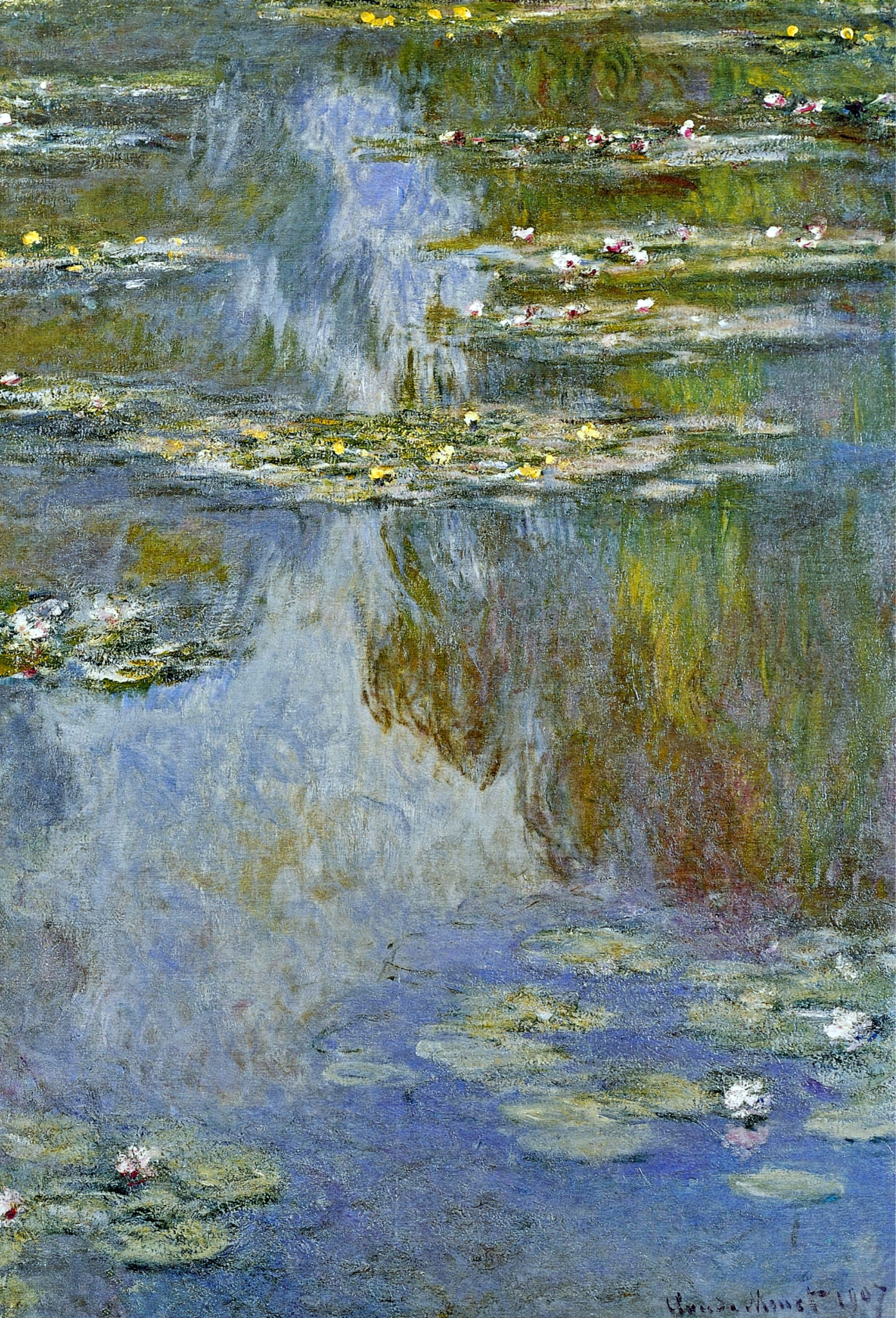
The horizonless waterscape shows me lilies floating in the upside down sky. Everytime I look at lilies in a pond I think of Monet’s paintings. Every pond adds to my experience of his paintings. Or his paintings add to each experience of a pond.
Monet, like Wilbur, turned the world upside down and made me feel as though I could swim in the sky. The funny thing is, I am swimming in the sky — especially during a hot and humid summer.
Shouldn’t it be enough to just enjoy the sky and the surface of a pond as they are? In their proper places?
I say no. I say the voice of praise will search out any way to see a part of creation “fresh.” To add more experience onto the past. To layer life as deep and dense as possible.
Propaganda which has something to say, only tells you what you already know. Art, by twisting things awry — by uncreating — reveals more to experience, more to savour, more to enjoy, more and more reason to sing praises every day.
Wilber’s “Praise in Summer” reminds me of these lines from Chesterton’s “Orthodoxy”:
“This is proved by the fact that when we are very young children we do not need fairy tales: we only need tales. Mere life is interesting enough. A child of seven is excited by being told that Tommy opened a door and saw a dragon. But a child of three is excited by being told that Tommy opened a door. Boys like romantic tales; but babies like realistic tales—because they find them romantic. In fact, a baby is about the only person, I should think, to whom a modern realistic novel could be read without boring him. This proves that even nursery tales only echo an almost pre-natal leap of interest and amazement. These tales say that apples were golden only to refresh the forgotten moment when we found that they were green. They make rivers run with wine only to make us remember, for one wild moment, that they run with water.”
As you say, “It’s a wonderful, child-like, way of seeing the world.”