


Paul Elie, in his wonderful book The Life You Save May Be Your Own, defines the word pilgrimage as, “a journey taken in light of a story.”1 2 I would be foolish not to highlight that Elie’s inspiration stemmed from a work of art. Art helped him notice the connections between four authors in order to explore how pilgrimage occurs in America.
Elie’s book provides wonderful insight but regardless of the content, the definition itself has stuck with me. I have been on pilgrimages before (none of the traditional sacred ones… yet!) and his definition is correct. I went to Japan as a pilgrim because of the stories I had heard. I moved to Boston because of the stories I had heard. I went to the Rothko Chapel in Texas because of the stories I had heard. The list goes on, as I am sure your list would as well.
The entire notion of pilgrimage and journey has come to my mind because Lent is a journey. In fact, for me it is a pilgrimage — I just read a great book about Lent called The Good of Giving Up which is a collection of stories about the power of this journey. While practicing Lent I don’t go very far geographically, but I am taken somewhere — with a rumbling stomach. In light of this realization, the Lenten journey and my position as a pilgrim, I’d like to ponder some works of art which relate to journeying and pilgrimage and more importantly, deprivation.
One Year Performance 1980-1981,
by Tehching (Sam) Hsieh
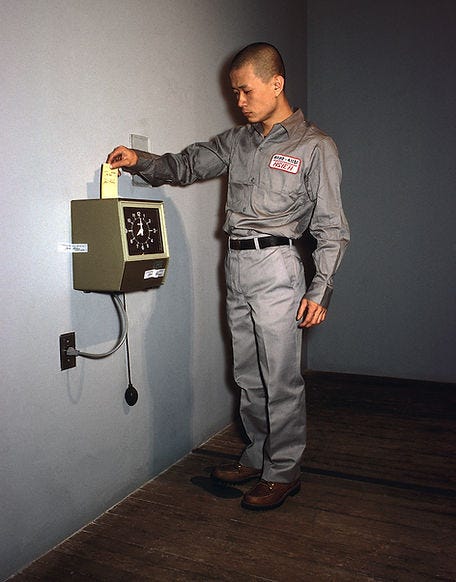
Performance art is innately related to journeying since the artwork itself unfolds over time. This relation also applies to a novel because stories are how we string together the account of a journey.
In this strange performance, artist Tehching Hsieh spent one year clocking in on a time clock every hour on the hour. Meaning he slept no longer than 55 or so minutes the entire year, aside from the times he missed.
Luckily, he documented his failures as well as his successes:
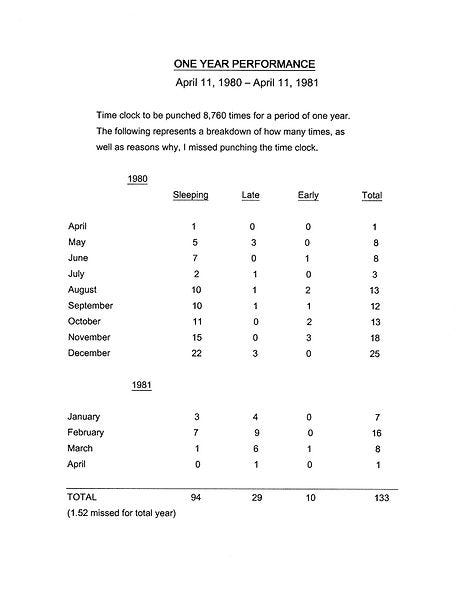
Before the performance began, he cut his hair. Each time he clocked in, he took a photo of himself, using his hair growth to visually represent the journey. The images are often displayed as well as a film including each of the 8,760 images and black frames for the hours he missed:
This would be a hellish journey, a new layer in Dante’s Inferno, somewhere close to the bottom. As a work of art it does not attract me — it repels me. I feel the suffering, the exhaustion, the toll this task would take on his body. I wonder about his health, physical and mental. I wonder about blisters on the feet of pilgrims walking the Camino right now.
This artwork reminds me of the many ways we count time. The ways we construct our days around clocks. The absurdity and monumental nature of the performance highlight the inhuman way the clock divides the hours of the days. The question bubbles to the top of my mind: “Well, then, how do I divide up my time and is it somehow more natural?”
The artwork jolts me outside my normal view of time and makes me realize I have not often considered how I spend my time. Even the word, “spend,” makes me wonder if it’s even reasonable to consider time mine to spend?
