


Today in the church calendar we celebrate Saint Luke. Which has me thinking about healing — and not just because he was a physician. It’s because of the way he has been depicted through Christian iconography.
St. Luke is the OG1 renaissance man. He was the writer of The Gospel of Luke and the book of Acts. Which makes him a historian, well, a documenter of the times. He was a doctor. Obviously an evangelist. But, oddly enough, he was the first Christian iconographer. The skill tree includes writer, physician and artist.
The Monastery of St. Luke in Jerusalem has one of his icons:
Icon of the Blessed Virgin Mary, ca 50
believed to be by Luke the Evangelist
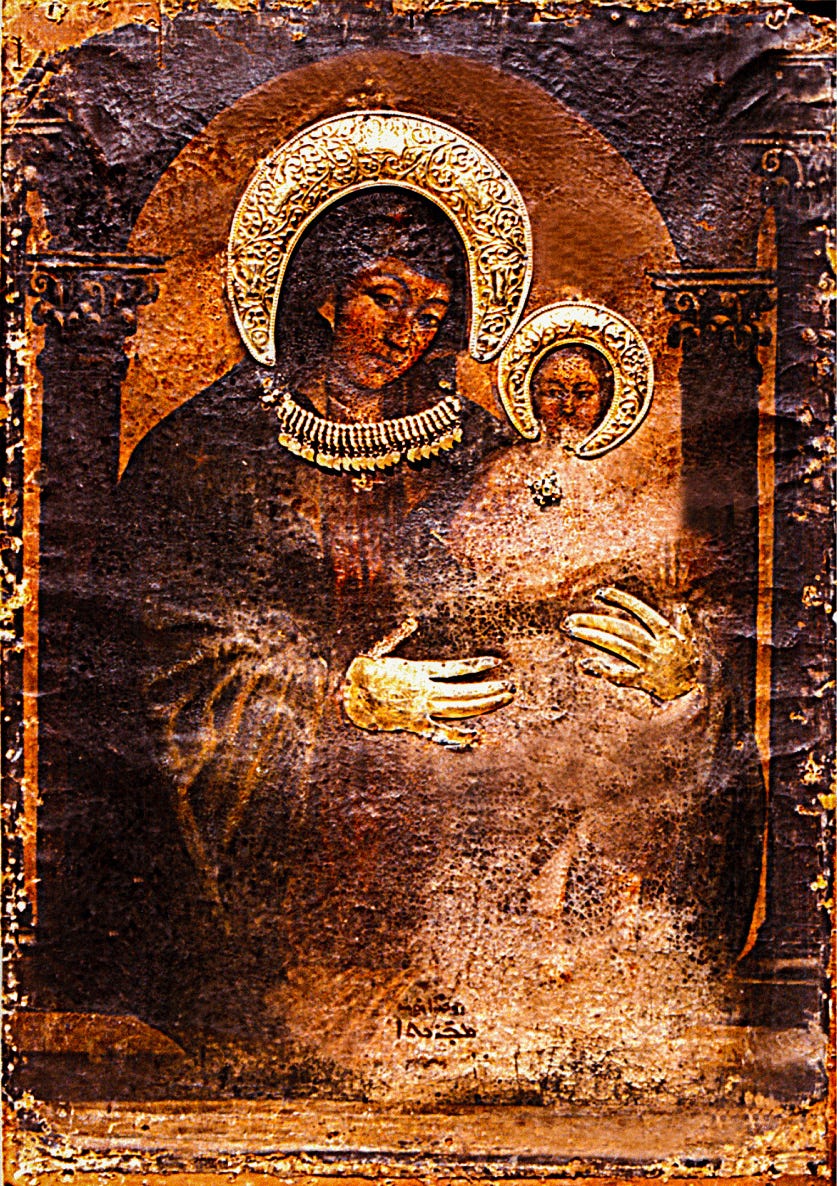
St. Luke is often depicted with Mary because of the details of his gospel. Unlike the other gospel writers he was interested in detail. The details of his gospel meant that he had to have interviewed Mary. He asked what those early days were like. The great Christmas stories of shepherds and magi, Luke laid them down in his journal. Add journalist to his CV.
Saint Luke Painting the Virgin Madonna, 1532
by Maarten van Heemskerck
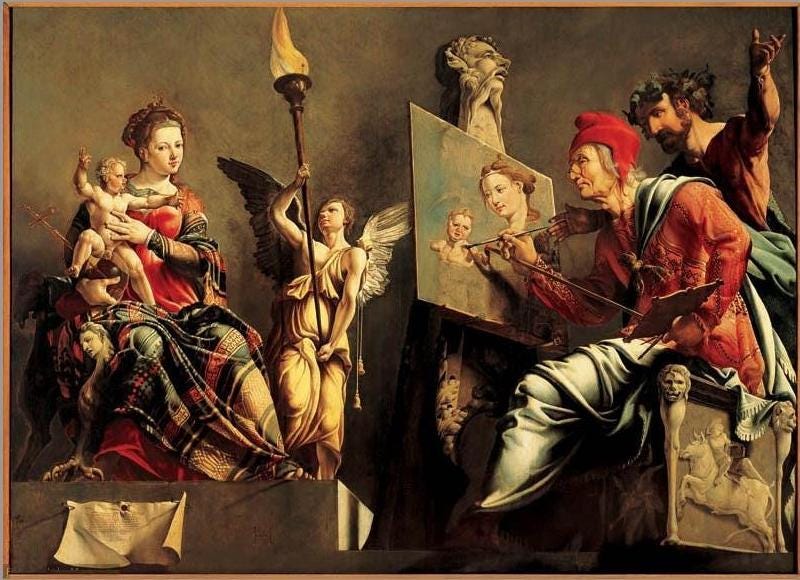
Later depictions of Luke often show him carefully detailing the image of Mary much like he detailed her account of Christ’s birth and the subsequent acts of the apostles. Note the spectacles and the rod to steady his hand while painting.
The angle of this painting is a bit weird. It was made to hang high up on a wall so that the perspective made more sense to the viewer. The Madonna looks down at the viewer while we look up at everyone else. Another strange detail is that Heemskerck depicted Luke as a dutch baker. I have no clue why. Maybe we should add baker to the list of Luke’s skills.
There are more common themes amongst his depictions, the angel instructing, the Virgin with Child as can be seen here:
Winged Altar of the Guild of Saint Luke, 1484
by Herman Rode
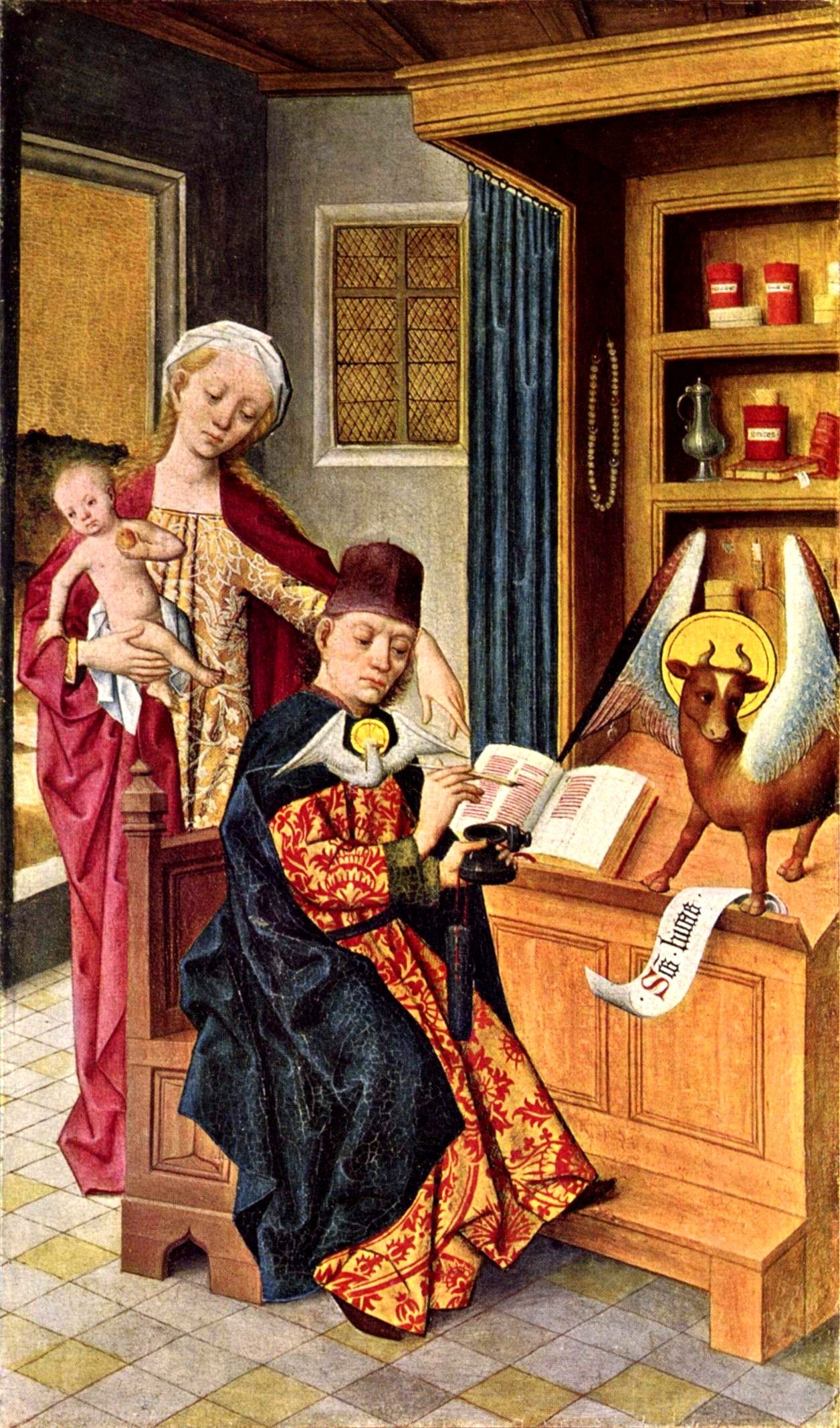
In most depictions his hand is guided either by the Virgin or an angel. But there is one other detail that is more noticeable in this image. None of these paintings depict him as a healer or doctor. He doesn’t even have a stethoscope.2 It is not the outward appearance or the actions of healing but rather the strangest detail of all.
What the heck is with the winged oxen? It was on the throne “baker Luke” is sitting on in the first image as well. In van Heemskerck’s painting it is more discrete compared to the mini bull chilling on the edge of Rode’s writing desk!
Luke is symbolized by the ox because his book begins with Zechariah — the father of John the Baptist — performing his priestly duties. Luke’s gospel focuses on the sacrifice of Christ and the ox was a sacrificial animal. The oxen was sacrificed on the day of Atonement in first and second temple Judaism.
Luke documents the end of the sacrificial system, the end of the slaughter of oxen, because, as was promised Abraham, “God himself will provide the lamb…”
The sacrificial connotations of the ox, mixed with the fact that Luke was a physician, makes me think of the changes in society because of religion. Religion has been the great civilizing force of humanity. Specifically sacrificial religion.
Luke was the journalist who documented the next great shift in religion and civilization. Much like this image:
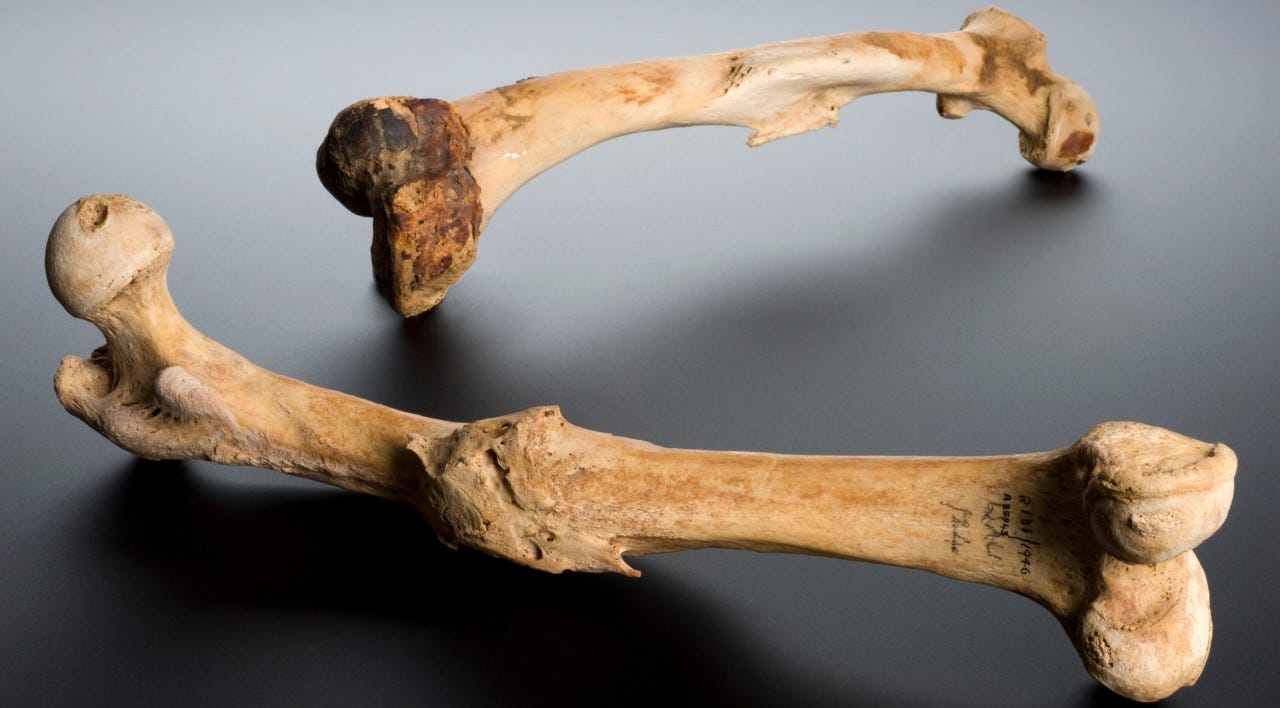
This is a left femur from the Science Museum of London. You might notice there is something strange happening to the middle of the bone. It’s not a tumor. It is the sign of a broken bone that has been able to heal.
Margaret Mead, an anthropologist, said that the first sign in the archeological record of civilization was a healed femur bone. Why? Before civilization of any kind, if someone broke their femur, they died. A healed femur meant that society allowed for the caretaking of an injured person until they could walk again.
What would have been required of a tribe for one of its members to heal a broken femur while they followed the herds on foot? The herd moves on. The oxen roam. The first healers must have been the ones who carried the injured for weeks until the bone had set. They sacrificed their backs for their tribesman’s ability to walk, run, and hunt with them again.
It’s hard to imagine doing that unless you had a sacred reason why. This is the lineage of the winged ox. The sacred animal who is sacrificed so that the world can be healed. The physician and the priest are brothers.3
Christ is the lamb. He is the ram. He is the serpent lifted on a pole. He is the goat and the scapegoat. He is the ox without blemish. I am amazed by the menagerie of animals Jesus Christ embodies through symbolism.
St. Luke’s careful study, his documentation of the details, encourages me as an artist. His documentation with words and image reveal the only ox who had no blemish. The only ox worthy of wings. The only ox who can heal not just femurs but can heal all wounds. The self sacrifice to end all sacrifice.
Merriam Webster determines this bit of slang to mean the original. I find that appalling. Instead I turn to the far more accurate dictionary, the Urban Dictionary, for the true meaning: Original Gangsta. St. Luke was a late addition to the leather jacket wearing Apostles but he was as original as they come. In terms of skills, he surpassed the fishermen and tax collectors of the lot. His only rivals in terms of word count in the New Testament would be Paul and John. Paul mended tents. Hardly renaissance level. And John, well he was loved by Jesus. So, you know, great and all, but not as skilled as Luke. Luke is the Napoleon Dynamite of the whole crew — I bet when the Kingdom comes we will find out he was good with nunchakus as well.
The only true sign someone is a doctor.
That is why witches can be doctors.